What is atonement: understanding the theology of the cross
Explore the profound mystery of atonement, where divine justice, mercy, and love intersect at the cross.
The ancient question of atonement
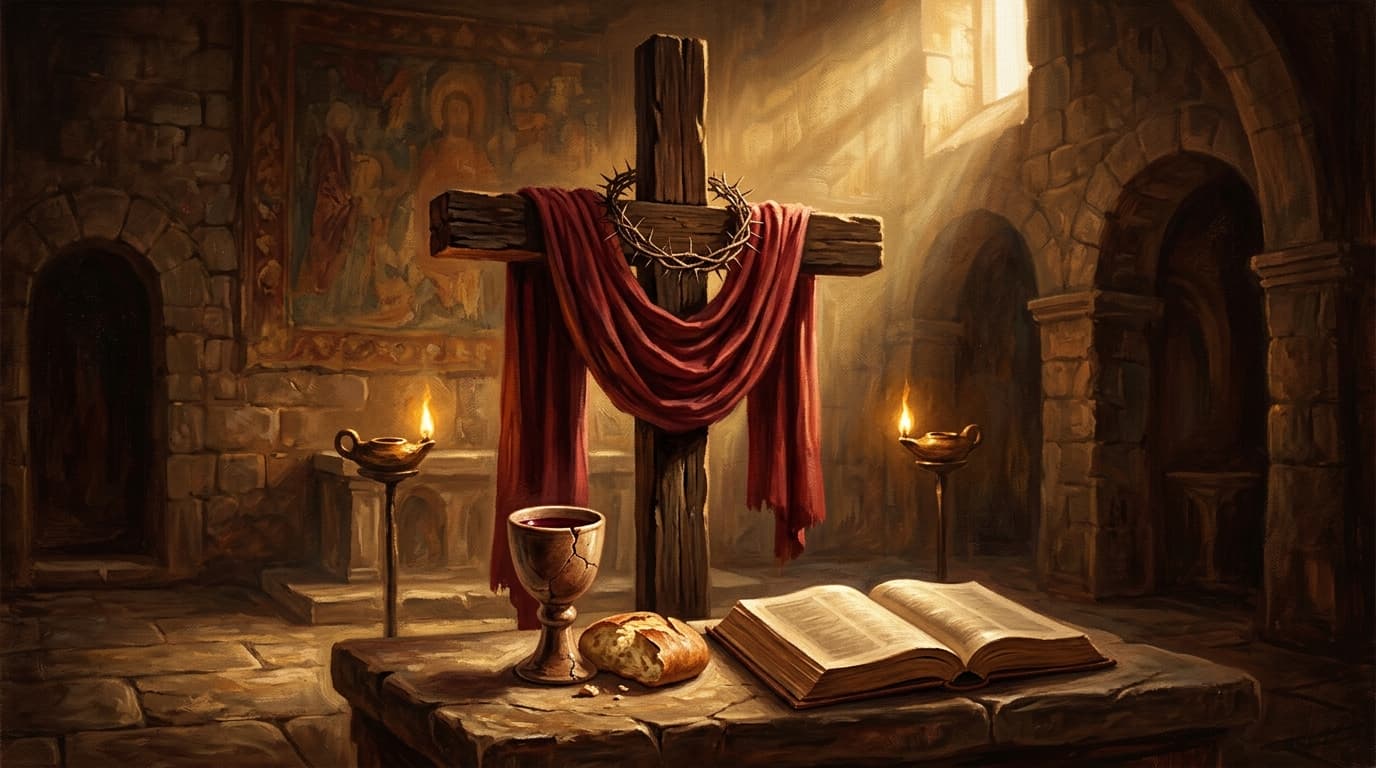
Suppose you were to find yourself in the dusty streets of first-century Jerusalem, amidst the cacophony of daily life. As you walk past the Temple, you might see priests leading lambs toward the altar, their bleating a poignant reminder of an ancient ritual. These sacrifices were meant to atone for sins, a concept that feels both foreign and familiar to us today. But what exactly is atonement, and how does the cross of Christ fulfill this profound mystery?
In its simplest form, atonement is a reconciliation, an act that restores a broken relationship. The English word "atonement" itself is derived from "at-one-ment," signifying a state of unity or peace. Yet, the theology of atonement, particularly as it relates to the cross, is anything but simple. It is a tapestry woven from threads of divine justice, mercy, and love.
Atonement in the Old Testament
To understand the depth of atonement, we must turn to the Old Testament, where the concept is deeply rooted. In , we find the ritual concerning an unsolved murder. The elders of the nearest town, unable to find the murderer, must perform a ceremony involving a heifer. They wash their hands over the animal, declaring their innocence. This ritual is an early form of atonement, where the innocent suffers to cover the guilt of another.
Similarly, the Day of Atonement, described in , involved the high priest entering the Holy of Holies to offer sacrifices for the sins of the people. The blood of goats and bulls was sprinkled to cleanse the sanctuary, symbolizing the removal of sin. But as the author of reminds us, these sacrifices were but shadows, unable to truly remove sin.
The cross: Atonement fulfilled
Fast forward to the New Testament, where the crucifixion of Jesus is the ultimate act of atonement. As explains, Christ entered not an earthly sanctuary but the very presence of God, offering his own blood, not that of animals, for the redemption of humanity.
The cross is where justice and mercy meet. One might object that the idea of blood sacrifice is barbaric or outdated. But consider the gravity of sin and the holiness of God. Sin creates a chasm between humanity and the divine. Through the cross, Jesus bridges this divide, offering himself as the perfect sacrifice.
In , Paul writes, "While we were still sinners, Christ died for us." This is not merely an act of substitution; it is a demonstration of God's profound love and justice. Justice demands that sin be addressed; love ensures that it is done so with mercy.
Theories of atonement: Different lenses
Throughout Christian history, theologians have sought to understand and explain how the cross achieves atonement. Three primary theories emerge: the ransom theory, the satisfaction theory, and the moral influence theory.
The ransom theory, championed by early Church Fathers like Origen of Alexandria, posits that Christ's death was a ransom paid to liberate humanity from the bondage of sin and death. While compelling, some argue it overemphasizes the power of evil, as if God owed something to the devil.
The satisfaction theory, articulated by Anselm of Canterbury, suggests that Christ's death satisfied the demands of divine justice. Humans, unable to render proper honor to God, needed Christ to restore this balance. Yet, critics like N.T. Wright warn against viewing this as a mere transactional necessity.
The moral influence theory, popularized by Peter Abelard, views the cross as a demonstration of God's love, intended to inspire human hearts to repentance and transformation. While emphasizing God's love, it risks downplaying the seriousness of sin.
A multifaceted mystery
Each theory offers a lens through which to view the atonement, yet none captures its entirety. Atonement, like a diamond, reflects different facets of God's heart. Charles Hodge notes in his Systematic Theology that atonement involves not only reconciliation but also satisfaction of divine justice.
"It is easy to imagine that it carries a single and obvious meaning. It does not," writes N.T. Wright in The Day the Revolution Began. He emphasizes that atonement is deeply embedded in the story of Israel, culminating in Jesus.
The cross and the kingdom
There is a danger in separating the cross from the kingdom of God. As Wright argues in How God Became King, the cross is not merely about personal salvation but is the means by which God's kingdom breaks into the world. Through the cross, Jesus defeats the powers of sin and death, inaugurating a new creation.
This kingdom aspect of atonement invites us to live differently. It is not merely about being saved from sin but being saved for something, a life of righteousness and participation in God's mission.
Living in response to atonement
So, what does living in light of atonement look like? It begins with gratitude, recognizing the cost of our redemption. Timothy Keller reminds us that understanding the depth of atonement should transform how we live. It calls us to deep gratitude and radical generosity.
The cross calls us to forgive as we have been forgiven, to love as we have been loved, and to serve as we have been served. It challenges us to embrace our role in God's redemptive story, living as agents of justice and peace.
Atonement in the New Testament
The New Testament presents atonement through the lens of Jesus Christ's life, death, and resurrection. The apostle Paul asserts in that Christ "died for our sins according to the Scriptures, that he was buried, that he was raised on the third day." This foundational claim underscores the centrality of atonement in the Christian faith. The New Testament writers consistently affirm that Jesus' sacrificial death was the means by which humanity is reconciled to God.
Paul's Epistle to the Romans, particularly , articulates the concept of reconciliation, emphasizing that through Jesus' death, believers are justified and saved from God's wrath. The Epistle to the Hebrews further elaborates on Jesus as the high priest who offers himself as the ultimate sacrifice, fulfilling and surpassing the Old Testament sacrificial system ().
The New Testament also highlights the transformative nature of atonement. In , Paul speaks of the new creation brought about by reconciliation through Christ. Here, atonement is not merely a transactional event but a dynamic change in the believer's identity and relationship with God. Theologian N.T. Wright emphasizes that this redefinition of identity is crucial, as it invites believers to participate in the life of Christ and the mission of God in the world.
The role of suffering in atonement
The suffering of Christ is a crucial component of the atonement, embodying both the depth of human sin and the extent of divine love. The prophet Isaiah foreshadowed this suffering in the "Suffering Servant" passages, notably , which describe a figure who bears the iniquities of many. The New Testament writers interpret Jesus' suffering and crucifixion as the fulfillment of this prophecy, as seen in .
Theologians have long grappled with the implications of Christ's suffering. Anselm of Canterbury, in his work "Cur Deus Homo," posits that the suffering and death of Christ were necessary to satisfy divine justice. Conversely, Jürgen Moltmann, in "The Crucified God," suggests that Christ's suffering reveals God's solidarity with human suffering and his commitment to overcoming evil and death.
In the context of atonement, suffering is not viewed as punitive but redemptive. It is a conduit through which restoration and reconciliation are achieved. The cross, therefore, becomes a symbol of both the horror of sin and the hope of redemption, inviting believers to embrace their own sufferings in light of Christ's ultimate sacrifice ().
Atonement and the concept of justice
Atonement is intimately linked with the concept of divine justice. The biblical narrative portrays God as a just and righteous judge who demands accountability for sin, yet also as merciful and loving. This tension is resolved through the atonement, where justice and mercy meet at the cross.
In , Paul explains that God presented Christ as a sacrifice of atonement to demonstrate his righteousness. This act satisfies the demands of justice while providing a path for mercy. Theologian Karl Barth, in "Church Dogmatics," emphasizes that atonement reveals God's justice as not merely retributive but restorative, aimed at healing the breach caused by sin.
The cross exemplifies this balance of justice and mercy. By bearing the penalty for sin, Jesus upholds the righteousness of God, while simultaneously offering forgiveness and reconciliation to humanity. This dual aspect challenges believers to reflect God's justice and mercy in their own lives, promoting a justice that seeks restoration rather than retribution ().
Atonement and the cosmic scope
The atonement extends beyond individual salvation to encompass the entire cosmos. The apostle Paul in speaks of Christ's work as reconciling "all things, whether things on earth or things in heaven," highlighting the universal scope of the cross. This cosmic reconciliation is a key theme in the theology of Irenaeus, who posits that through Christ, all of creation is being brought back into harmony with its Creator.
The cosmic scope of atonement suggests that the cross has implications for the entirety of creation, not just humanity. This perspective challenges believers to consider their role in the restoration of creation, advocating for environmental stewardship and social justice as expressions of God's redemptive plan. N.T. Wright argues that the work of atonement is about launching God's new creation, urging the church to participate in God's mission of renewal in every sphere of life.
Moreover, the cosmic dimension of atonement affirms the ultimate victory over evil and chaos. In , the promise of a new heaven and new earth underscores the transformative power of Christ's atoning work, where God's dwelling is with humanity, and death and suffering are no more. This eschatological hope inspires believers to live in anticipation of the fullness of God's kingdom.
Atonement and the community of believers
Atonement not only reconciles individuals to God but also establishes a new community, the church, as the body of Christ. In , Paul describes how Christ's death broke down the dividing wall of hostility, creating one new humanity out of diverse peoples. This aspect of atonement emphasizes the communal dimension of salvation, where reconciliation with God leads to reconciliation with others.
The early church fathers, such as Augustine, emphasized the corporate nature of atonement, viewing the church as a "city of God" united by Christ's redemptive work. This communal identity challenges the individualistic tendencies of contemporary culture, calling believers to live out the implications of atonement in community, marked by love, forgiveness, and mutual support ().
also, the communal aspect of atonement highlights the church's mission as an agent of reconciliation in the world. As ambassadors of Christ, believers are entrusted with the message of reconciliation, tasked with embodying the values of the kingdom in their relationships and social structures (). This mission reflects the heart of atonement, which is not only about personal salvation but the transformation of communities and societies in alignment with God's redemptive purposes.
A question that lingers
As we ponder the cross, a question remains: How do we, in our time, live out the reality of this atonement? The journey does not end at the foot of the cross; it begins there. We walk forward, carrying with us the mystery of a God who became man to reconcile the world to himself.
In closing, we return to that bustling street in Jerusalem. The rituals and sacrifices have ceased, but the echo of atonement remains, a testament to a love that would stop at nothing to bring us home.
If you are curious about how the cross relates to God's kingdom, the answer is intertwined with God's plan for the world. To explore different theories of atonement, dive into the rich history of theology that seeks to explain this profound mystery.