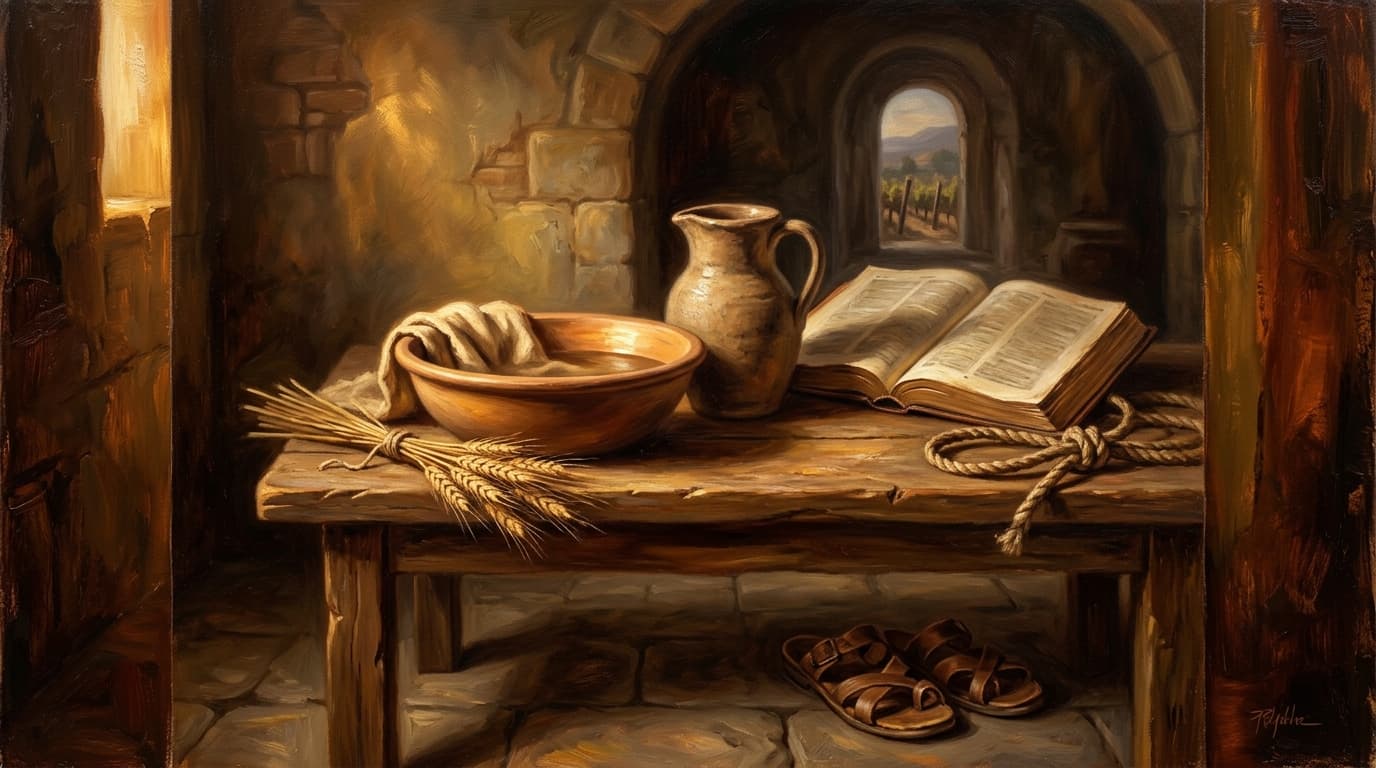
Belief: meaning, Bible context, and common misunderstandings
Belief, often seen as mere mental assent, is deeply woven into the fabric of biblical faith. It shapes the contours of discipleship, community, and transformation.

What does belief really mean?
Suppose someone asked you, "What does it mean to believe?" Would your answer start with a creed, a feeling, or a practice? In the Christian tradition, belief is not a static concept, but a dynamic force shaping lives and communities through history. It demands more than intellectual assent; it invites transformation.
When we turn to the Bible, we find belief at the heart of both personal faith and communal identity. But what exactly does belief entail, and how has its understanding evolved within the church?
The roots of belief in Scripture
Biblical belief begins with a radical trust. In , we find the first disciples leaving their nets to follow Jesus after merely hearing John the Baptist declare, "Behold, the Lamb of God!" This was no small decision. For them, belief meant a shift of allegiance, a willingness to leave behind previous securities for an unknown path.
The term "belief" in the New Testament often translates the Greek word pistis, which encompasses trust and faithfulness, not mere intellectual agreement. In , the early believers are described as "continuing steadfastly in the apostles' teaching and fellowship." Their belief was not a solitary affair; it was lived out in community through shared meals, prayers, and resources.
Belief as discipleship
Belief is foundational to discipleship, as Jesus makes clear in . Here, Jesus calls Simon Peter and Andrew with the simple invitation, "Come after Me, and I will make you fishers of men." The immediacy of their response, leaving their nets and following Him, illustrates belief not just as a concept, but as a transformative action.
John Calvin, in his Institutes of the Christian Religion, defines faith as "a firm and certain knowledge of God's benevolence toward us," which compels us towards obedience and trust. Calvin stresses that belief is a deep-seated conviction that results in a life oriented towards God, a commitment that encompasses both mind and heart.
The communal dimension of belief
The early church's life together, as depicted in Acts, is a vivid illustration of belief as a communal journey. In , Paul and Barnabas "strengthen the souls of the disciples, exhorting them to continue in the faith." Here, belief sustains community through encouragement and shared trials, emphasizing the necessity of collective perseverance.
Theologian Richard Baxter, in A Christian Directory, emphasizes that faith is not only a personal trust in God but also involves "learning of Christ as his disciples." This entails a communal aspect where believers are mutually edified and equipped for service. The church, therefore, becomes a living testament to the power of belief, as faith feeds into the life and mission of the community.
Interpretive tensions and misunderstandings
One might object that belief is often reduced to mental assent or cultural identity. Consider the modern parlance, where "belief" can mean little more than a private opinion. But the biblical narrative resists such reduction.
In , Paul instructs Timothy to "be a pattern of those believing", a call to visible, lived faith rather than abstract belief. Here, belief is portrayed as active, manifest in behavior, love, and purity.
Theologian Charles Spurgeon, reflecting on this passage, noted that "faith must be acted out," suggesting that genuine belief cannot remain hidden but shines through in practical piety and public witness.
The transformative power of belief
Belief, when properly understood, is transformative. It changes hearts, communities, and cultures. In , Paul describes how Scripture equips believers "for every good work." Here, belief is tied to action, as the knowledge of God inspires deeds of righteousness.
Timothy Keller, in his works on justice, argues that true belief inevitably leads to social action. If you wonder how belief connects to social justice, consider that biblical faith inherently carries the weight of responsibility towards others, manifesting in acts of love and justice.
Historical shifts in understanding belief
Throughout history, the church has wrestled with the meaning of belief. In the early church, belief was often expressed through the creeds, a collective affirmation of faith against heresies.
During the Reformation, figures like John Calvin and Martin Luther refocused belief on personal trust in Christ rather than mere ritual observance. Luther, in particular, emphasized sola fide, or "faith alone," as the means of justification, challenging the prevailing notions of merit and works.
Belief and modern misconceptions
Today, belief often gets entangled with the tides of subjective experience or cultural trends, leading to misunderstandings. Some view belief as a private, inward experience, disconnected from the external world.
But biblical belief, as we've seen, is both deeply personal and inherently communal. It calls into question what it means to truly follow Jesus, challenging Christians to consider how their beliefs materially shape their lives and the world around them.
Conclusion: Rediscovering belief
Returning to that original question, what does it mean to believe?, we find that belief in the Christian context is a journey of trust and transformation. It is not merely about what we assent to mentally but about who we follow, how we live, and whom we join in fellowship.
As we walk this path, we might recall the image of those early disciples, leaving their nets behind, not knowing fully where they were headed, but certain of whom they were following. This is belief: an ongoing journey, a lived reality, forever calling us deeper into the mystery of faith.
Historical development of belief in Christianity
The concept of belief within Christianity has evolved significantly from the early church to the present day. Initially, belief was primarily about allegiance to Jesus as the Messiah and adherence to the teachings of the apostles. In the Book of Acts, the early followers of Jesus are described as those who "devoted themselves to the apostles' teaching and to fellowship" (). This communal and doctrinal aspect of belief was crucial for the nascent Christian community.
As Christianity spread beyond Jewish communities into the Greco-Roman world, belief began to incorporate philosophical elements from the surrounding culture. Theological figures such as Augustine of Hippo emphasized belief as intellectual assent to certain truths, alongside faith and trust in God. Augustine argued that belief is a step toward understanding, famously stating, "I believe to understand." This fusion of faith and reason became a cornerstone of Christian theology.
The Reformation brought another shift in the understanding of belief. Martin Luther and John Calvin emphasized "sola fide" (faith alone) as the means of justification, which positioned personal belief as central to salvation. This emphasis on individual belief had profound implications for the development of Protestant theology, stressing the personal relationship between the believer and God.
In contemporary times, belief in Christianity is often seen as both a personal conviction and a communal identity. Theologians like Karl Barth have highlighted the existential aspect of belief, focusing on the decision to trust in God's revelation in Christ. Barth argued that true belief is a response to the divine Word, an act of faith that transcends mere intellectual agreement. Thus, the historical development of belief in Christianity illustrates a dynamic interplay between doctrinal, philosophical, and personal dimensions.
Belief and doubt in the life of faith
Doubt is often perceived as the antithesis of belief, yet it plays a significant role in the life of faith. The Bible presents numerous examples of individuals who struggled with doubt while maintaining a relationship with God. Thomas, one of Jesus' disciples, famously doubted the resurrection until he could see and touch Jesus' wounds (). Rather than condemning Thomas, Jesus offered him the evidence he needed, demonstrating that doubt can be part of a genuine journey of faith.
Theologians like Paul Tillich have argued that doubt is an integral component of belief. Tillich suggested that doubt is not the opposite of faith, but an element within it. He believed that a faith without doubt is static and potentially naive, whereas a faith that embraces doubt is dynamic and alive. This perspective encourages believers to engage with their doubts, seeing them as opportunities for deeper understanding and growth.
In practical terms, doubt can lead to a more robust and mature faith. When believers confront their uncertainties, they are often driven to explore theological questions more deeply, seek counsel from wise mentors, and engage in prayerful reflection. This process can lead to a renewed and strengthened belief that is both intellectually and spiritually satisfying.
The story of Job in the Old Testament exemplifies this journey. Job's intense questioning and wrestling with God amidst his suffering led to a profound encounter with the divine and a deeper understanding of God's nature (). Thus, doubt is not an enemy of belief but a potential pathway to a more authentic and resilient faith.
The role of community in shaping belief
Christian belief is not formed in isolation but is deeply influenced by the community. From the earliest days of the church, communal worship, teaching, and fellowship have played a crucial role in nurturing and shaping individual faith. In the New Testament, the author of Hebrews exhorts believers to "not give up meeting together" but to encourage one another (). This underscores the importance of community in sustaining and growing belief.
Theologian Dietrich Bonhoeffer emphasized the necessity of Christian community in his work "Life Together." Bonhoeffer argued that believers need the presence and encouragement of other Christians to maintain their faith. He wrote, "The Christian needs another Christian who speaks God's Word to him," highlighting that belief is strengthened through mutual edification and accountability.
In contemporary settings, small groups, Bible studies, and church gatherings provide spaces for believers to explore their faith, ask questions, and support one another. These communal interactions offer diverse perspectives and insights that can enrich individual understanding and conviction.
Moreover, the community is essential for transmitting the faith to future generations. Through teaching, mentoring, and modeling, seasoned believers pass on their faith experiences and theological insights to younger members. This intergenerational aspect of community helps to preserve the core tenets of belief while allowing for adaptation and growth.
Thus, the role of community in shaping belief is multifaceted, offering support, accountability, and a rich environment for theological reflection. Believers are reminded that their faith journey is part of a larger story that includes others who have traveled the path before them and those who will follow.
The impact of culture on belief
Culture plays a significant role in shaping and expressing belief within Christianity. As the gospel has spread across diverse cultural contexts, it has both influenced and been influenced by the surrounding culture. This interaction between faith and culture can be seen in the way Christian beliefs are articulated, practiced, and understood.
In the early church, the spread of Christianity into the Hellenistic world led to the incorporation of Greek philosophical concepts into Christian theology. The works of early church fathers like Origen and Tertullian reflect this synthesis, as they sought to articulate the Christian faith using the philosophical language of their time.
In modern times, the relationship between culture and belief continues to evolve. Liberation theology, for instance, emerged in Latin America as a response to socio-political conditions and emphasized God's preferential option for the poor. Theologians like Gustavo Gutiérrez have argued that the gospel speaks directly to the struggles and injustices faced by marginalized communities, influencing how belief is understood and lived out in those contexts.
Similarly, in Western societies, where individualism and secularism are prevalent, expressions of belief often emphasize personal faith and spiritual experience. This can be seen in the popularity of evangelical and charismatic movements that focus on personal conversion and direct encounters with God.
However, the impact of culture on belief also presents challenges. Theologian Lesslie Newbigin highlighted the danger of cultural captivity, where the church's message becomes indistinguishable from the surrounding culture. He called for a critical engagement with culture, where believers discern how their faith can both affirm and challenge cultural norms.
In essence, culture profoundly shapes Christian belief, offering both opportunities for contextual expression and challenges that require discernment and fidelity to the core message of the gospel.