What Is Pentecost? Acts 2 and the Birth of the Church
A clear guide to Pentecost in Acts 2, explaining the Jewish feast, the coming of the Holy Spirit, Peter's sermon, and the birth of the church.
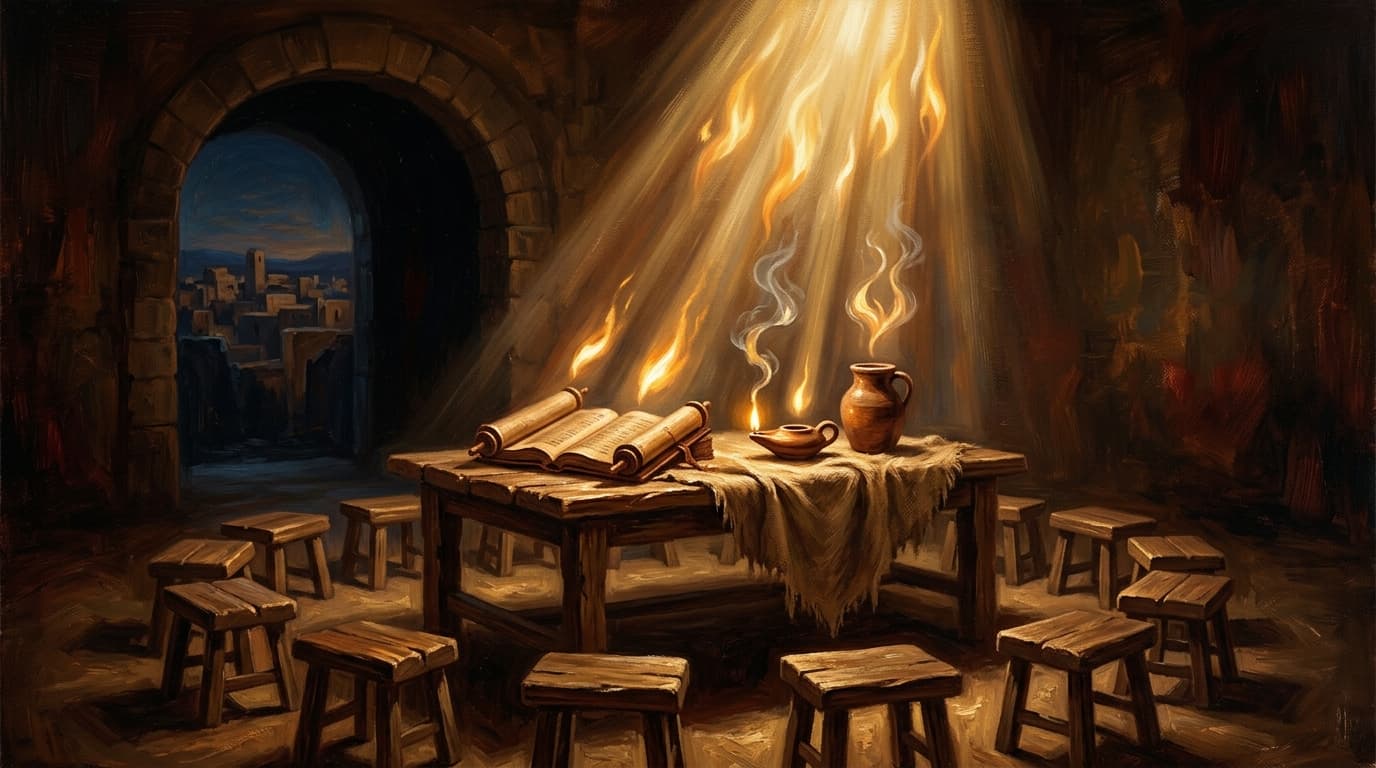
When the day of Pentecost arrived, something extraordinary happened that forever altered the course of history. In a room in Jerusalem, a group of Jesus' followers experienced an event that would mark the birth of the Church. This was no ordinary gathering but a moment when heaven touched earth, when the Holy Spirit descended and empowered the disciples, as described in . But what is Pentecost, and why is it so significant?
The historical roots of Pentecost
To understand the full significance of the Pentecost event, we must first explore its origins. In the Jewish tradition, Pentecost was known as the Feast of Weeks, or Shavuot, a celebration marking the completion of the wheat harvest, 50 days after Passover. It was also a time to commemorate the giving of the Torah at Mount Sinai. This dual significance in agriculture and revelation set the stage for the new meaning it would acquire in the Christian tradition.
N.T. Wright reminds us that the early church would have understood Pentecost within this framework, a time for thanking God for both physical and spiritual provision. However, with the resurrection of Jesus, Pentecost became the day when the new covenant was inaugurated, with the Holy Spirit now indwelling believers, as promised by Jesus before his ascension ().
The Spirit descends: explained
Suppose you were one of the followers gathered in that room on the day of Pentecost. You would have felt the sudden rush of a mighty wind and seen what appeared to be tongues of fire resting on each person. This vivid imagery is not just an artistic flourish; it symbolizes the powerful and purifying presence of the Holy Spirit.
Luke describes this scene in , where the Spirit filled the disciples, enabling them to speak in various languages. This miraculous occurrence was not a random spectacle but a divine sign, reversing the confusion of languages at Babel. Here, language became a means of unity, enabling the gospel to be heard by "devout men from every nation under heaven" ().
Theologians like John Chrysostom have noted the significance of this moment, likening the Spirit's descent to the sickle at harvest time. Pentecost, therefore, becomes the first great ingathering of souls, a spiritual harvest that mirrors the agricultural festival.
Peter's sermon: A call to repentance
After the Spirit's arrival, Peter stands up to address the bewildered crowd. His sermon, recorded in , cuts to the heart of the Jewish listeners by connecting the events they witnessed to the prophecies of Joel and the resurrection of Jesus. Peter's message is clear: the Jesus they crucified is both Lord and Messiah.
In a keen rhetorical move, Peter calls the crowd to "repent and be baptized, every one of you, in the name of Jesus Christ for the forgiveness of your sins" (). This invitation is not merely about personal transformation but marks the entry into a new community of believers, the Church.
Charles Spurgeon remarked on the power of Pentecost to convict hearts. He noted that the same Spirit that empowered Peter's words is available to believers today, urging them to witness with boldness.
The birth of the Church:
With the outpouring of the Spirit and the response to Peter's message, about three thousand people were added to the Church that day (). This was not just a numerical increase but the formation of a new kind of community.
The early Church, as described in , devoted themselves to the apostles' teaching, fellowship, breaking of bread, and prayer. They lived with "gladness and simplicity of heart," sharing their possessions so that none among them was in need.
This communal life was a reflection of the Spirit's indwelling and a testimony to the world of God's transformative power. Charles Hodge observed that the Church at Pentecost is a model for Christian communities, demonstrating unity and generosity as fruit of the Spirit's work.
The ripple effect: Pentecost and the spread of the Gospel
The events of Pentecost did not remain confined to Jerusalem. As the Spirit-filled believers began to preach, the message of Jesus spread rapidly. recounts how the persecution following Stephen's martyrdom led to the dispersion of believers, who carried the Gospel to places like Antioch.
The Church at Antioch became a hub for missionary activity, demonstrating the global vision of the Holy Spirit's work. This pattern continued as Paul and other apostles embarked on missionary journeys, inspired and empowered by the same Spirit that rushed in on Pentecost.
The symbolism of fire and wind at Pentecost
The events of Pentecost as described in are marked by the powerful symbols of wind and fire, both of which carry deep theological significance. The sound of a mighty rushing wind that filled the house where the disciples were gathered () is emblematic of the Holy Spirit's dynamic presence. Wind in Scripture often symbolizes the Spirit of God, as seen in the Hebrew word "ruach," which means both "wind" and "spirit" (). Wind signifies the invisible yet impactful movement of the Spirit, a force that can neither be controlled nor contained by human hands.
Similarly, the tongues of fire that appeared and rested on each believer () echo the purifying and illuminating work of the Spirit. Fire in the Old Testament often represents God's holiness and presence, as seen in the burning bush encountered by Moses (). John the Baptist prophesied that Jesus would baptize with the Holy Spirit and fire (), suggesting a transformative purification. The fire at Pentecost signifies the sanctifying work of the Spirit, setting believers apart and empowering them for mission. Augustine of Hippo described this moment as a divine illumination, where the Spirit's fire kindles the hearts of believers to shine as lights in the world.
These symbols at Pentecost underscore the Spirit's role in shaping and empowering the nascent Church. The wind and fire illustrate the transformative power of the Spirit, renewing believers and equipping them with gifts for service, thereby ensuring the Church's mission is carried forward with divine authority.
The role of Pentecost in the unity of believers
Pentecost is not only significant for the birth of the Church but also for its role in unifying believers. Before Pentecost, the disciples were a group of individuals with different backgrounds, experiences, and personalities. However, the outpouring of the Holy Spirit brought about a profound unity among them, enabling them to speak in languages they had not learned, thus bridging cultural and linguistic divides. This unity is a fulfillment of Jesus' prayer for his followers, that they may be one even as He and the Father are one ().
The miraculous ability to speak in various tongues () demonstrated the Spirit's unifying power, reversing the division of languages at the Tower of Babel (). At Babel, humanity's pride led to confusion and division; at Pentecost, the Spirit's descent led to understanding and unity. Theologian Karl Barth emphasized that the Holy Spirit creates fellowship among believers, drawing diverse individuals into one body through the bond of peace ().
This unity is not uniformity but a rich diversity that reflects the multifaceted nature of God's kingdom. It enables the Church to be a witness to the world, as Jesus declared that the unity of believers would testify to His divine mission (). Pentecost is a reminder that the Church is called to embody the inclusive love of God, celebrating diversity while maintaining unity through the Spirit.
The empowerment for mission
Pentecost marks the beginning of the Church's mission to the world, empowered by the Holy Spirit. When Jesus instructed His disciples to wait in Jerusalem for the promise of the Father (), He was preparing them for their mission to be His witnesses "in Jerusalem, and in all Judea and Samaria, and to the ends of the earth" (). The descent of the Holy Spirit at Pentecost provided the necessary empowerment for this mission.
The filling of the Holy Spirit equipped the apostles with boldness and clarity to proclaim the Gospel, as seen in Peter's sermon, where he boldly declared the resurrection of Christ (). Theologian John Stott notes that the Spirit's presence at Pentecost was not a mere historical event but the initiation of an ongoing empowerment for the Church's mission throughout the ages.
The Spirit grants believers gifts that are essential for mission, such as wisdom, knowledge, faith, healing, and prophecy (). These gifts enable the Church to address the needs of the world, demonstrating the love and power of God. An example of this empowerment is seen in the life of Paul, whose missionary journeys, inspired and directed by the Spirit, spread the Gospel across much of the Roman Empire (Acts 13-28).
Pentecost teaches that the Church's mission is not a human endeavor but a Spirit-led movement, requiring dependence on God's power rather than human strength. The Spirit's empowerment ensures that the message of Christ continues to reach the ends of the earth, fulfilling the Great Commission ().
Pentecost and the fulfillment of prophecy
The events of Pentecost are deeply connected to the fulfillment of Old Testament prophecies, particularly those concerning the outpouring of the Spirit. In his sermon, Peter cites the prophet Joel, declaring that the events witnessed by the crowd were a fulfillment of Joel's prophecy: "I will pour out my Spirit on all people" (, ). This prophecy indicated a new era in salvation history, where God's Spirit would be available to all, regardless of age, gender, or social status.
Pentecost also fulfills the promise of a new covenant, as prophesied by Jeremiah and Ezekiel. Jeremiah spoke of a time when God's law would be written on the hearts of His people (), and Ezekiel envisioned a new heart and spirit given to God's people, enabling them to follow His decrees (). At Pentecost, these promises come to fruition as the Spirit indwells believers, transforming their hearts and minds.
The theologian John Calvin emphasized the continuity between the Old and New Testaments, viewing Pentecost as the culmination of God's redemptive plan revealed throughout Scripture. The outpouring of the Spirit signifies a new creation, where believers are regenerated and empowered to live according to God's will.
Pentecost is a reminder of God's faithfulness to His promises and the ongoing work of the Spirit in bringing about His kingdom on earth. It points to the eschatological hope of the full realization of God's kingdom, where the Spirit's presence will be fully manifested in a renewed creation.
Pentecost and the restoration of Israel
Pentecost holds significant implications for the restoration of Israel, as it represents the initial fulfillment of God's promises to His chosen people. The gathering of devout Jews from every nation () reflects the diaspora, yet the outpouring of the Spirit signals the beginning of Israel's spiritual restoration. Peter's sermon emphasizes that Jesus is the promised Messiah, and His resurrection is the cornerstone of this restoration ().
The restoration of Israel is a recurring theme in the prophetic books, where God promises to gather His people and restore their fortunes (). The events of Pentecost are a foretaste of this fulfillment, as the Spirit unites Jewish believers and draws them into a renewed covenant community. Theologian N.T. Wright argues that Pentecost is a pivotal moment in the narrative of Israel's restoration, as the Spirit's outpouring marks the beginning of God's kingdom breaking into the present age.
This restoration is not limited to ethnic Israel but extends to all who believe in Christ, as Paul explains that true Israel consists of those who are children of the promise (). Pentecost thus signifies the expansion of God's covenant to include Gentiles, fulfilling the promise to Abraham that all nations would be blessed through his offspring ().
The Church, as the new Israel, is called to embody the restored relationship with God and to serve as a light to the nations, proclaiming the Gospel and participating in God's redemptive work in the world. Pentecost is a reminder of God's faithfulness to His covenant promises and His desire to restore all creation through the Spirit's transformative presence.
The ongoing significance of Pentecost
Pentecost is not merely an ancient event but a present reality. The same Spirit that descended on the apostles continues to empower believers today. The day of Pentecost marks the Church's birth but also its continual renewal.
In contemplating the historical and theological significance of Pentecost, we recognize it as a moment when God's promise was realized in a powerful and transformative way. The Spirit's descent was a divine declaration that God's presence would dwell with His people, enabling them to fulfill their mission in the world.
This understanding challenges us to ask how we witness the Spirit's work in our lives today. Are we living as a community that embodies the unity and generosity of the early Church? Are we open to the Spirit's leading in our personal and communal lives?
As we ponder these questions, let us remember the wind and the fire of Pentecost, a moment when heaven touched earth and forever changed the landscape of human history. The Church is still being built, one soul at a time.