Good Friday Meaning: Why the Cross Changes Everything
Good Friday remembers Jesus' crucifixion and death. Learn why Christians call the day good and how the cross shapes forgiveness, suffering, and hope.
What is the meaning of Good Friday?
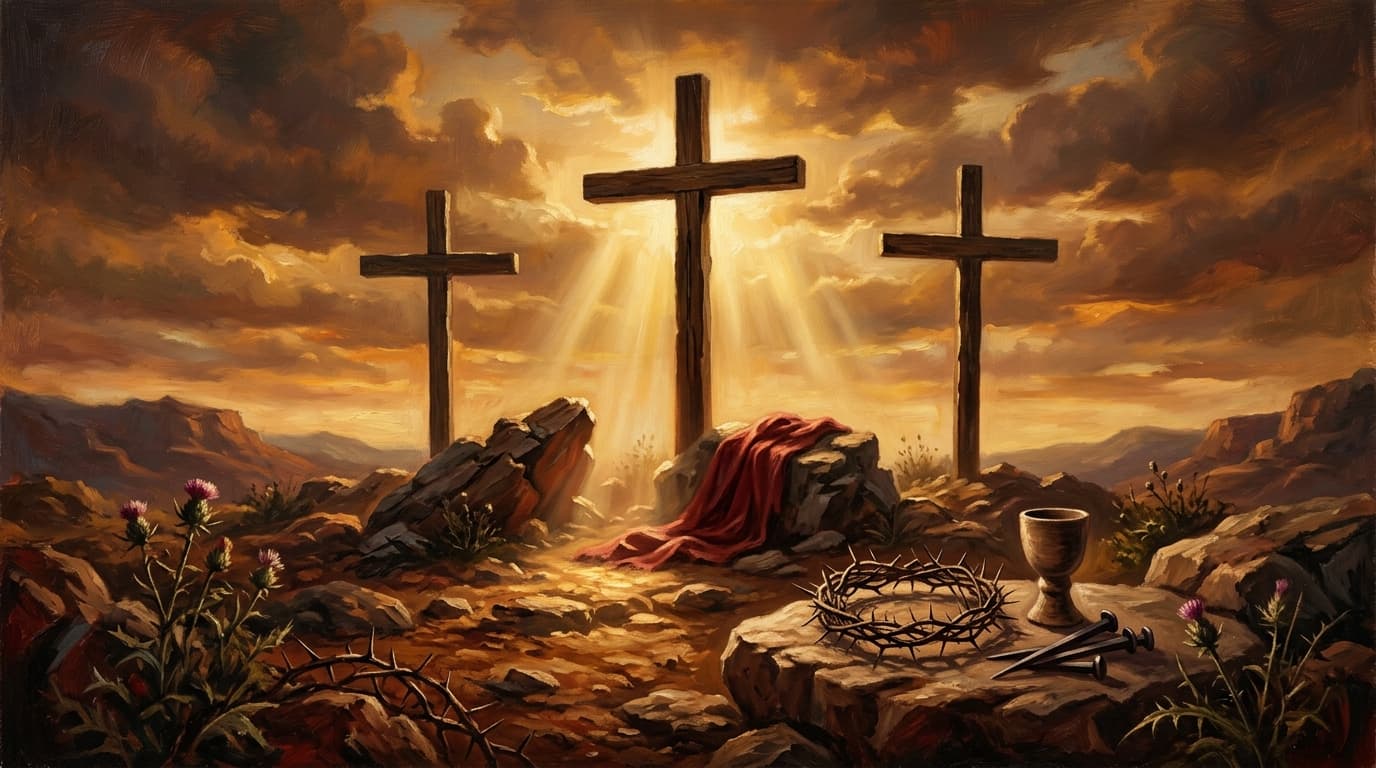
Short answer: Good Friday means Christians remember the day Jesus was crucified, died, and was buried. It is called good because Christians see the cross through Easter: human sin and violence reach their worst point, and God turns that place into forgiveness, reconciliation, and victory over death.
Good Friday is therefore not a celebration of suffering for its own sake. It is the day the church looks at the cross and says that God's love goes all the way down into human evil, grief, and shame in order to redeem it.
The road to Golgotha: a moment in time
Imagine a narrow, dusty road leading out of Jerusalem. The air is thick with the smell of sweat and anticipation, a crowd pressing in from all sides. At the center of this throng, a man stumbles under the weight of a wooden cross. It is Good Friday, though no one in that moment calls it good.
This scene, as described in and the synoptic Gospels, marks the beginning of the crucifixion narrative. Here, Jesus, already scourged and mocked, makes His way to Golgotha, the "Place of the Skull." The Romans have perfected crucifixion as a method of execution, not just for its brutality but for its public spectacle. It is a warning, a demonstration of imperial power.
Yet, for Christians, this is not merely an execution; it is the turning point of history. The cross, rather than a mere instrument of death, becomes the symbol of life, hope, and transformation. But how can such a brutal event be seen as good? Why does this particular Friday stand out against the backdrop of history as a day of profound significance?
The scandal of the cross: foolishness and power
To the Greeks, the notion of a crucified savior was utter foolishness; to the Jews, it was a scandal. In , Paul writes, "For the word of the Cross is foolishness to those who are perishing, but to us who are being saved it is the power of God." Here lies the paradox: what appears as weakness and folly to the world is, in fact, the epitome of divine strength.
This tension is at the heart of much theological debate. How can the cross, an instrument of Roman oppression, become the means of salvation? According to Charles Hodge, it is through the covenant of redemption that the cross achieves its purpose. In his Systematic Theology, Hodge explains that the cross is central to the reconciliation between God and humanity, a theme echoed throughout Scripture.
John Chrysostom, in his Homilies, describes the cross as "the safety of our life," a shield against the devil and a symbol of redemption. "Through it all things are done," he writes, emphasizing its role in the sacraments and daily Christian living.
The crucifixion: a new enthronement
One might object that Jesus' death on the cross was a defeat, a failed attempt at revolution, but consider the inscription above His head: "THE KING OF THE JEWS." This was not merely a sarcastic jab by Pilate. In the divine narrative, it signifies a new kind of enthronement. N.T. Wright argues that Jesus' crucifixion was His enthronement as king, a moment where the powers of evil were overcome not by force but by the power of self-giving love.
In , Jesus speaks to the "daughters of Jerusalem," foretelling the suffering to come. His words, "Father, forgive them," mark a radical shift in understanding power and victory. It is here, at the cross, that the true nature of God's kingdom is revealed, not through conquest, but through sacrifice. This same ethic — power exercised through dignity rather than domination — runs through the Sermon on the Mount, where Jesus teaches his followers to turn the other cheek rather than retaliate.
Historical perspectives: the cross through the ages
The early Church Fathers, like Irenaeus of Lyon and Leo the Great, saw the cross as the ultimate act of divine love and justice. Irenaeus, in his work Against Heresies, posits that the cross is the fulfillment of God's promise to humanity, a theme that Leo echoes in his sermons, emphasizing the glory of the cross "which irradiates heaven and earth."
Throughout history, theologians have wrestled with the meaning of Good Friday. Martin Luther viewed it as a moment of profound personal and communal significance, where humanity is justified by faith through Christ's sacrifice. His writings often emphasize the individual's relationship to the cross, a perspective that influenced the Protestant Reformation.
The cross and the modern world: implications for today
In our contemporary context, Good Friday challenges us to reconsider our understanding of power and victory. It invites us to embrace a paradoxical way of living, where losing one's life means gaining it, as Jesus taught in .
The crucifixion teaches us about the cost of discipleship. "Whoever wants to be my disciple must deny themselves and take up their cross and follow me," Jesus declares. This call to action resonates deeply in a world that often glorifies self-preservation and success.
The cross as a symbol of reconciliation
The cross is the ultimate symbol of reconciliation, bridging the chasm between humanity and God. This reconciliation is fundamentally theological, emphasizing God's initiative in restoring a broken relationship with humankind. The Apostle Paul articulates this in his letter to the Colossians: "For God was pleased to have all his fullness dwell in him, and through him to reconcile to himself all things, whether things on earth or things in heaven, by making peace through his blood, shed on the cross" (). This passage highlights the cosmic scope of reconciliation, where the cross not only addresses individual sin but also the restoration of all creation to its intended harmony.
Theologians such as Karl Barth have underscored the cross as God's definitive act of reconciliation. Barth writes, "In the death of Jesus Christ, God speaks his last word to the world... it is the word of reconciliation" (Church Dogmatics, Volume IV). This perspective emphasizes that reconciliation is not merely a human endeavor but is initiated and completed by God through Christ's sacrificial act.
Concrete examples of the cross as a symbol of reconciliation can be seen in various Christian practices and liturgies. For instance, the sacrament of Communion is both a remembrance of Christ's sacrifice and a communal participation in the peace and unity brought by the cross. also, ecumenical movements often use the cross as a unifying emblem, symbolizing the shared foundation of faith across diverse Christian traditions.
The cross and human suffering
The cross of Christ offers profound insights into the nature of human suffering, presenting a paradigm in which suffering is neither meaningless nor the final word. In the Gospel of Matthew, Jesus' cry from the cross, "My God, my God, why have you forsaken me?" (), echoes the depths of human anguish and abandonment. Yet, within this cry lies a profound identification with human suffering, indicating that God is not distant from human pain but has entered into it fully.
Dietrich Bonhoeffer, in his reflections from prison, suggested that only a suffering God can help. He wrote, "The God who lets us suffer is the God who suffers with us" (Letters and Papers from Prison). Bonhoeffer's insights remind us that the cross is a source of comfort and solidarity for those enduring trials, as it reassures believers that God is intimately aware of and present in their suffering.
This understanding of the cross has practical implications for pastoral care and counseling. Pastors and counselors often draw upon the narrative of the cross to offer hope and meaning to those facing illness, loss, or despair. The cross provides a framework for understanding suffering in light of Christ's victory over death, offering the promise that suffering, while real and painful, will ultimately be transformed through the resurrection. For an in-depth look at what the earliest sources say about that resurrection — and why they make a stronger historical case than most people expect — the evidence goes back further than the Gospels.
The cross and the concept of justice
The crucifixion of Jesus is deeply intertwined with the concept of divine justice. Theologians have long grappled with how the cross satisfies the demands of justice, with Anselm of Canterbury famously articulating the satisfaction theory of atonement in his work, "Cur Deus Homo." Anselm posited that Christ's death was necessary to satisfy the justice of God, which had been offended by human sin.
This understanding is reflected in Scripture, as seen in , where Paul describes Christ as a sacrifice of atonement. The passage states, "God presented Christ as a sacrifice of atonement, through the shedding of his blood, to be received by faith... so as to be just and the one who justifies those who have faith in Jesus." Here, the cross is portrayed as the means by which God's justice and mercy converge.
Modern conversations about justice and the cross often extend beyond individual salvation to include social justice concerns. Liberation theologians, such as Gustavo Gutiérrez, argue that the cross calls Christians to engage in the struggle against systemic injustices and to stand in solidarity with the oppressed. The cross, in this view, compels believers to work towards a just and equitable society, embodying the justice of God in tangible ways.
The cross and the call to discipleship
The cross not only signifies salvation but also is a call to discipleship. Jesus' invitation to "take up their cross and follow me" () challenges believers to embrace a life of self-denial and sacrificial love. This call to discipleship is not merely an invitation to suffer but a summons to participate in the mission and character of Christ.
Dietrich Bonhoeffer, in "The Cost of Discipleship," famously declared, "When Christ calls a man, he bids him come and die." Bonhoeffer's statement encapsulates the radical nature of Christian discipleship, where following Christ involves a total reorientation of one's life around the values and priorities of the kingdom of God.
Examples of this call to discipleship are evident in the lives of countless Christians who have chosen paths of service and sacrifice. From missionaries who forsake comfort to serve in remote areas, to everyday believers who prioritize acts of kindness and justice in their communities, the cross as a call to discipleship manifests in diverse and impactful ways. The cross, therefore, not only changes individual destinies but also shapes lives committed to living out the transformative power of Christ's love in the world.
The cross and divine love
The cross stands at the center of Christian theology as the ultimate expression of divine love. In , the scripture declares, "For God so loved the world that he gave his one and only Son, that whoever believes in him shall not perish but have eternal life." This verse encapsulates the sacrificial nature of God's love, made manifest through the crucifixion. Theologian Karl Barth emphasized that the cross is not merely a demonstration of love but the very essence of God's love reaching into the human condition. Barth writes in "Church Dogmatics" that God's condescension through the cross is a divine initiative to restore broken relationships, showing the depth and breadth of His love.
Concrete examples of this divine love can be seen in the lives transformed by the message of the cross. Consider the Apostle Paul, who, once a persecutor of Christians, became a pivotal figure in spreading the message of Christ's love after his encounter with the risen Lord on the road to Damascus. Paul's letters, particularly , affirm that "God demonstrates his own love for us in this: While we were still sinners, Christ died for us." It is this transformative love that compels believers to love others, reflecting the sacrificial nature of God's love in their daily interactions and community life.
The cross and spiritual freedom
The cross symbolizes the liberation from the bondage of sin and death, offering spiritual freedom to all who embrace its significance. In , Paul writes, "It is for freedom that Christ has set us free. Stand firm, then, and do not let yourselves be burdened again by a yoke of slavery." This freedom is not merely an abstract concept but a lived reality that empowers believers to overcome the chains of sin. Augustine of Hippo, in his "Confessions," reflects on how the cross freed him from the shackles of his past, providing him with a new identity in Christ.
This freedom is vividly illustrated in the story of John Newton, the former slave trader who, after experiencing the grace of God, penned the hymn "Amazing Grace." His transformation is a testament to the liberating power of the cross, which breaks the yoke of sin and offers a new path of righteousness. As believers embrace this freedom, they are called to live lives that reflect the grace and mercy they have received, becoming agents of liberation in a world still bound by sin.
The cross and cosmic reconciliation
The cross signifies not only personal redemption but also cosmic reconciliation, bringing creation itself into harmony with God. In , Paul writes, "For God was pleased to have all his fullness dwell in him, and through him to reconcile to himself all things, whether things on earth or things in heaven, by making peace through his blood, shed on the cross." This passage highlights the comprehensive scope of the cross's redemptive work, extending beyond humanity to encompass the entire cosmos.
Theologian N.T. Wright, in "Surprised by Hope," articulates that the resurrection is the beginning of God's new creation, where the cross is the pivotal point of cosmic renewal. Wright argues that believers are called to participate in this cosmic reconciliation by living as stewards of creation, embodying the peace and restoration that the cross has inaugurated. Practical examples include environmental stewardship and social justice initiatives that reflect the reconciled order God intends for the world.
The cross, therefore, is a dynamic symbol of God's plan to restore all creation, inviting believers to engage actively in the mission of reconciliation and renewal. This cosmic perspective challenges Christians to consider the broader implications of the cross in their engagement with the world, fostering a holistic approach to faith that seeks the flourishing of all creation.
The cross and the power of forgiveness
Forgiveness is a central theme of the cross, offering a path to healing and restoration. In , Paul exhorts believers to "be kind and compassionate to one another, forgiving each other, just as in Christ God forgave you." The cross exemplifies the ultimate act of forgiveness, where Jesus intercedes for his persecutors with the words, "Father, forgive them, for they do not know what they are doing" ().
Dietrich Bonhoeffer, in "The Cost of Discipleship," argues that the cross calls Christians to a radical form of forgiveness that breaks the cycle of retaliation and violence. Forgiveness, according to Bonhoeffer, is not a sign of weakness but a manifestation of the cross's power to overcome evil with good. In practice, this is seen in stories of reconciliation, such as the Truth and Reconciliation Commission in South Africa, where victims and perpetrators of apartheid sought healing through the power of forgiveness.
By embodying the forgiveness offered at the cross, believers participate in the redemptive work of Christ, offering hope and healing in a fractured world. This act of forgiveness not only restores relationships but also transforms communities, reflecting the kingdom values inaugurated by the cross.
Conclusion: the enduring mystery of the cross
As we reflect on Good Friday, we find ourselves returning to the road to Golgotha, seeing it now transformed. The cross is a beacon, a symbol of God's unyielding love and the promise of redemption. It beckons us to live lives marked by the same self-giving love that Jesus exemplified.
The meaning of Good Friday is not locked in the past but alive and active today, calling each of us to a renewed understanding of what it means to follow the crucified King. The journey to the cross is one we are all invited to walk, with its mystery and power transforming us along the way.