How many chapters in 1 Samuel? A complete guide to the book's structure and content
1 Samuel has 31 chapters. The book follows three central figures — Samuel, Saul, and David — through one of the most pivotal transitions in Israel's history: the move from judges to kings. Here is a complete guide to the book's structure and most important passages.
How many chapters in 1 Samuel? A complete guide to the book's structure and content
Quick answer: 1 Samuel has 31 chapters. The book traces the transition of ancient Israel from a loose confederation of tribes led by judges into a unified monarchy, following three central figures: Samuel, Saul, and David. It is one of the most narratively rich books in the entire Old Testament.
The book we call "1 Samuel" was not always divided this way. In the Hebrew tradition, 1 and 2 Samuel were a single scroll — "the Book of Samuel." The division into two books came from the ancient Greek translation (the Septuagint), where the combined work was split for practical reasons of scroll length. Modern Bibles have retained that division.
So when you ask how many chapters are in 1 Samuel, the short answer . But understanding what those 31 chapters contain is what makes the number meaningful.
What Samuel about?
First Samuel tells the story of a hinge point in Israel's history — the moment the nation asked for a king.
Before Samuel, Israel was governed by judges: charismatic military leaders raised up by God in times of crisis. There was no centralised power, no standing army, no capital city. After Samuel, there would be a king, a dynasty, and eventually a temple. The book of 1 Samuel sits at that hinge.
Three figures dominate the narrative:
Samuel — the last of the judges and the first of a new kind of prophet. Born to Hannah in answer to a desperate prayer, Samuel grows up in the tabernacle at Shiloh, hears God call his name in the night, and becomes the spiritual and political authority of his generation.
Saul — the first king of Israel. Tall, handsome, from the tribe of Benjamin. He starts well and ends badly. His story is one of the Old Testament's most psychologically complex portraits of a leader who loses his way.
David — introduced first as a shepherd boy and harpist, David's story begins in 1 Samuel and continues through 2 Samuel. He kills Goliath, befriends Saul's son Jonathan, survives Saul's jealousy and repeated attempts on his life, and emerges as Israel's defining king.
The 31 chapters of 1 Samuel: a section-by-section overview
Chapters 1–7: Samuel's birth, call, and early ministry
The book opens with one of the Bible's most moving stories of personal faith. Hannah, one of two wives of a man named Elkanah, is barren and deeply grieved. She prays in the tabernacle with such intensity that the priest Eli thinks she is drunk. God hears her prayer. She conceives and names her son Samuel — which she explains as "I asked him of the LORD."
Hannah dedicates Samuel to God's service and brings him to Shiloh, where he serves under the aging Eli. In these early chapters, Eli's own sons are corrupt — stealing the sacrificial offerings and sleeping with women at the tabernacle entrance. God's judgment falls on the house of Eli, and the young Samuel becomes his replacement.
The pivotal moment comes in chapter 3: the LORD calls to Samuel in the night. Three times, the boy runs to Eli thinking the old priest has called him. On the third occasion, Eli understands what is happening and tells Samuel to answer: "Speak, LORD, for your servant is listening." This chapter establishes Samuel as a genuine prophet — one to whom God speaks and who speaks truthfully to Israel.
Chapters 8–15: The rise and fall of Saul
Chapter 8 is the turning point of the entire book. The elders of Israel come to Samuel and say: "Give us a king to judge us like all the nations." Samuel is grieved. God tells him: "They have not rejected you; they have rejected me." But God tells Samuel to give them what they want — and to warn them about what kingship will cost.
Samuel anoints Saul in chapter 10. The Spirit of God comes upon Saul, and he prophesies among the prophets. He wins early military victories against the Ammonites (chapter 11). But the cracks appear quickly.
In chapter 13, facing the Philistines and waiting for Samuel to arrive and offer sacrifice, Saul grows impatient and offers the sacrifice himself — a duty reserved for the priest. Samuel arrives and delivers the verdict: Saul's kingdom will not endure.
The decisive break comes in chapter 15. God instructs Saul to completely destroy the Amalekites — a difficult command that raises hard theological questions. Saul disobeys, sparing the best livestock and the Amalekite king Agag. When confronted, Saul claims the animals were spared for sacrifice. Samuel's response is one of the most quoted passages in 1 Samuel: "Does the LORD delight in burnt offerings and sacrifices as much as in obeying the LORD? To obey is better than sacrifice."
God rejects Saul. Samuel anoints a replacement.
Chapters 16–31: David's rise and Saul's descent
Chapter 16 introduces David. God sends Samuel to Bethlehem to anoint one of Jesse's sons. Jesse presents seven sons. God rejects each one. Samuel asks if there are any others. There is one more — the youngest, out tending the sheep. David is brought in: "ruddy, with beautiful eyes, and handsome." God tells Samuel: "Rise and anoint him; this is the one." The Spirit of the LORD comes on David from that day forward.
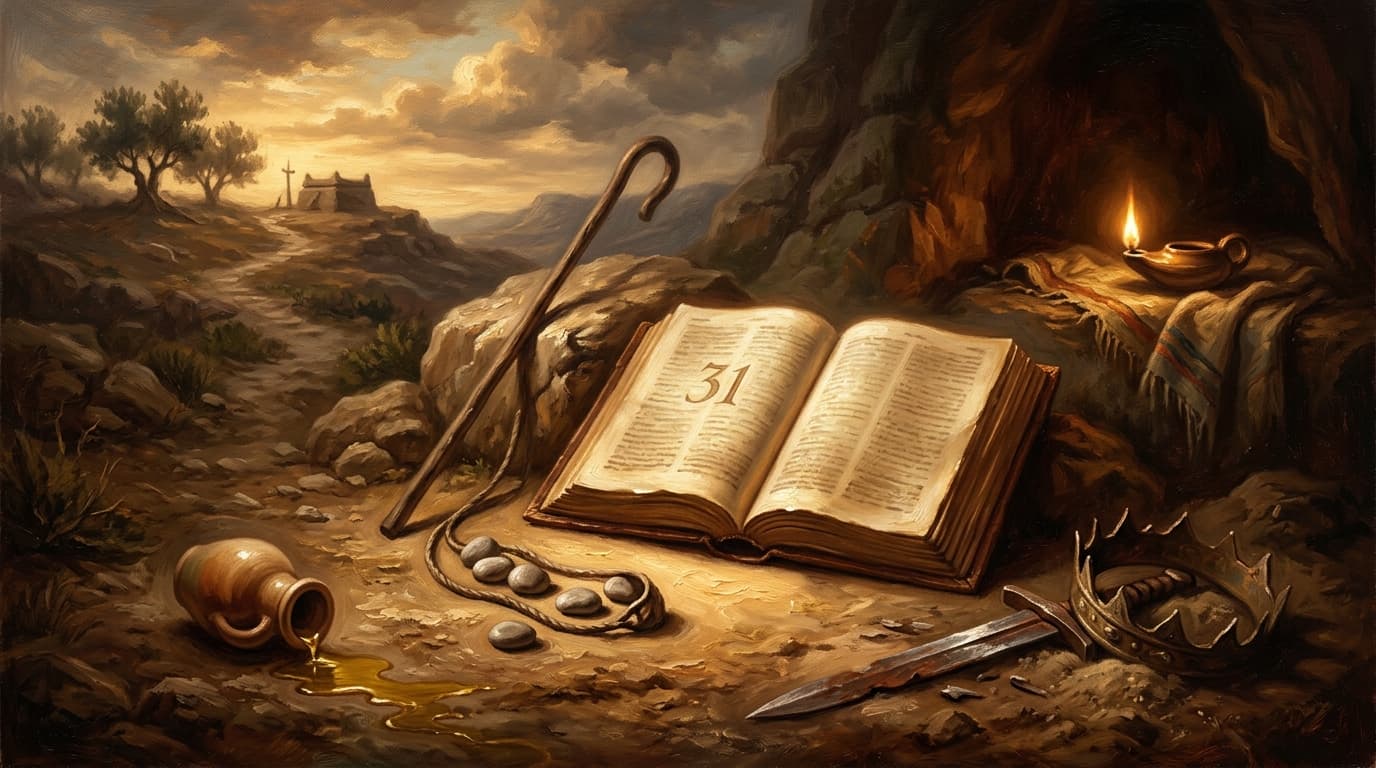
The famous Goliath narrative follows in chapter 17. The Philistine giant has been taunting Israel's army for forty days. David, a teenager sent to bring food to his brothers, hears Goliath's challenge and cannot understand why no one responds. He volunteers. Saul dresses him in armour, but David takes it off — he is not accustomed to it. He takes five smooth stones from a stream, his sling, and his shepherd's staff. One stone. Goliath falls.
The friendship between David and Jonathan, Saul's son, is one of the Old Testament's most striking relationships. Chapter 18 describes it with remarkable language: "the soul of Jonathan was knit to the soul of David." Jonathan gives David his robe, armour, sword, bow, and belt — essentially transferring his status as crown prince to the man he loves.
From chapter 18 onward, Saul's jealousy of David intensifies. He tries to kill David with a spear (twice). He plots to have the Philistines kill him by demanding a bride price no one should survive collecting. He sends assassins to David's house. He hunts David across the wilderness of Judah with his army.
Through it all, David refuses to harm Saul. Twice he has the opportunity to kill the king: once in a cave at En-gedi (chapter 24), once in the camp at night (chapter 26). Both times he refuses: "The LORD forbid that I should do this thing to my lord, the LORD's anointed." This restraint is central to David's character — and connects directly to the ethic Jesus would later articulate about turning the other cheek.
The book ends on a note of tragedy. Saul, facing a Philistine army he cannot overcome, visits a medium at Endor (chapter 28) to summon the spirit of Samuel. Samuel, even in death, has no comfort for him. The battle at Mount Gilboa (chapter 31) is devastating: Saul's sons are killed, including Jonathan. Saul, wounded by arrows, falls on his own sword rather than be captured and tortured by the Philistines.
The Philistines hang his body on the wall of Beth-shan. Men from Jabesh Gilead — a city Saul saved early in his reign — travel through the night to retrieve and bury the bodies. It is a small act of loyalty to a king who did not deserve it, and it is quietly moving.
Key themes in 1 Samuel
The cost of faithless leadership
Saul's tragedy is not simply moral failure. It is the failure to understand that kingship in Israel was different from kingship among "all the nations." The king was not the supreme authority — God was. Saul's repeated disobedience reflects a fundamental confusion about where authority lies.
The formation of character under pressure
David's years as a fugitive form him in ways that royal life never could. He learns to lead, to hold loyalty from men who have nothing to gain, to trust God in desolate places. The Psalms attributed to David in this period — if they are genuine — show someone who learned prayer through desperation. The Psalms as a collection are inseparable from the narrative of 1 Samuel.
The weight of God's choice
The pattern in 1 Samuel is consistent: God does not choose the obvious candidate. Not the eldest son. Not the tallest man. Not the experienced soldier. The pattern of unexpected election runs from Hannah's improbable pregnancy through David's unlikely anointing, and it establishes a theological principle that runs through the whole Bible.
Frequently asked questions about 1 Samuel
How many chapters are in 1 Samuel?
1 Samuel has 31 chapters and 810 verses. It is one of the longer narrative books of the Old Testament.
How many chapters are in 1 and 2 Samuel combined?
Together, 1 Samuel and 2 Samuel contain 55 chapters: 31 in 1 Samuel and 24 in 2 Samuel. In the original Hebrew tradition they were a single book.
What are the main stories in 1 Samuel?
The most well-known passages include Hannah's prayer and Samuel's birth (chapters 1–2), Samuel's call in the night (chapter 3), Saul's anointing and early reign (chapters 9–11), David and Goliath (chapter 17), David and Jonathan's friendship (chapters 18–20), David sparing Saul's life (chapters 24 and 26), and Saul's death at Gilboa (chapter 31).
Who wrote 1 Samuel?
Jewish tradition attributes authorship to Samuel himself, along with the prophets Nathan and Gad. Modern scholarship generally regards 1 Samuel as part of the Deuteronomistic History — a larger literary work that runs from Deuteronomy through 2 Kings, probably compiled and edited during the Babylonian exile period (6th century BC).
Samuel in the Old Testament or New Testament?
1 Samuel is in the Old Testament, in the section of books known as the "Former Prophets" in the Hebrew Bible, or "Historical Books" in Christian traditions.