What Does the Bible Say About Death and the Afterlife?
A biblical guide to death and the afterlife, tracing resurrection, judgment, the soul, eternal life, grief, and the Christian hope beyond the grave.
When we consider the profound question of what happens after death, we venture into territory that has both perplexed and consoled humanity for millennia. One might ponder: what does the Bible say about death? This question is not merely academic; it touches the core of human existence, prompting us to confront our mortality and seek meaning beyond the grave.
The sting of death and the promise of resurrection
In , the Apostle Paul addresses the heart of this inquiry with his profound discourse on resurrection. He speaks of a "secret": that not all will "sleep," but all will be transformed. This passage underscores a fundamental Christian belief: death is not the final curtain, but a transition to a transformed existence. Paul writes, "Where, O death, is your victory? Where, O death, is your sting?" suggesting that through Christ's victory, death has been swallowed up.
Suppose we lived in a world where death was the absolute end. Would life lose its urgency and its hope? The Christian narrative insists that resurrection is central, offering a future where our "mortal" puts on "immortality." This is not mere poetic hope; it is a tangible promise rooted in Christ's own resurrection, which Paul presents as the "firstfruits" of those who have died.
Jesus and the Sadducees: A debate on resurrection
In both and , Jesus engages with the Sadducees, a Jewish sect that denied the resurrection. The Sadducees presented a hypothetical scenario about a woman who married seven brothers, each dying without leaving offspring. They asked, "At the resurrection, whose wife will she be?"
Jesus responds not by debating the intricacies of marriage but by affirming the reality of resurrection. He asserts that in the resurrection, people "neither marry nor are given in marriage," illustrating a transformation of existence beyond earthly categories. "They are like angels," Jesus declares, "sons of God, being children of the resurrection." For Jesus, the resurrection is not a continuation of earthly life but entry into a divine community.
Judgment and the great white throne
Turning to the Book of Revelation, offers a vivid depiction of judgment following resurrection. John describes a "great white throne" before which the dead stand, both "great and small." Books are opened, and the dead are judged "according to what they had done."
This passage illustrates two critical themes: accountability and hope. The imagery of the "lake of fire" is sobering, representing a "second death" for those not found in the "Book of Life." Yet, the judgment is also a testament to God's justice, ensuring that evil does not prevail. It challenges readers to ponder their actions and their alignment with divine will.
The comfort of the resurrection
Paul's letters to the Thessalonians further elucidate the hope tied to resurrection. In , he comforts believers about those "who have fallen asleep," a euphemism for death. He reassures them that "the dead in Christ will rise first," and those alive "will be caught up together with them in the clouds to meet the Lord in the air."
Here, Paul invites believers to view death not as an end, but as a temporary state before a joyful reunion. The "shout," "voice of the archangel," and "trumpet call of God" propel this vision, embedding it with divine authority and urgency.
Resurrection: a theme of hope and renewal
The notion of resurrection is not confined to the New Testament. The Old Testament whispers it too, subtly preparing the ground for the fuller revelation in Christ. For instance, speaks of those who "sleep in the dust" awakening, "some to everlasting life, others to shame and everlasting contempt."
Theologians like Augustine of Hippo and Thomas Aquinas have wrestled with these concepts, exploring how resurrection affirms the goodness of creation and the body. Augustine, in his City of God, envisions a restored creation where the faithful enjoy eternal communion with God, a state free from suffering and death.
Engaging with different theological perspectives
Different Christian traditions offer varied interpretations of resurrection and judgment. The Orthodox Church emphasizes the transformation of the whole cosmos, while the Reformed tradition often focuses on personal salvation and divine sovereignty.
John Calvin argued for a "spiritual resurrection" experienced in the believer's life, already participating in Christ's victory. Meanwhile, Martin Luther emphasized the bodily resurrection, echoing Paul's teachings in 1 Corinthians.
Judgment: fearsome prospect or divine justice?
The concept of judgment can evoke fear, but it also underscores divine justice. N.T. Wright contends that scripture's portrayal of judgment is not about arbitrary condemnation but the restoration of right order. Judgment reaffirms the moral fabric of creation, offering hope that evil will not have the final word.
This tension invites further reflection. Suppose judgment was absent. Would justice prevail? The biblical narrative insists that judgment is integral to God's character, safeguarding the good.
Hope beyond the grave
Throughout scripture, the afterlife is framed not as an escape from the world but as its fulfillment. The resurrection does not negate creation; it redeems it. C.S. Lewis suggests in The Great Divorce that the afterlife is more real, more substantial than our current existence, a place where shadows become substance.
In sum, scripture paints a picture where death is a defeated enemy, resurrection is a divine promise, and judgment is the safeguard of justice. For those who ponder what happens after death according to the Bible, these themes offer comfort and challenge, urging a life aligned with eternal truths.
The nature of the soul after death
The Bible provides significant insight into the nature of the soul after death, a concept that has intrigued theologians for centuries. According to , "the dust returns to the ground it came from, and the spirit returns to God who gave it." This verse highlights the duality of human nature, comprising both the physical body and the immortal soul. The soul's journey after death is further explored in the New Testament, where Jesus' parable of Lazarus and the rich man in suggests a conscious existence in the afterlife.
Theologian Augustine of Hippo grappled with the nature of the soul, proposing that it remains conscious and aware between death and the final resurrection. His writings in "The City of God" emphasize that the soul's fate is immediately determined upon death, an idea that aligns with Jesus' words to the thief on the cross: "Truly I tell you, today you will be with me in paradise" ().
In contrast, the concept of "soul sleep," a belief held by some Christian denominations, suggests that the soul enters a state of unconscious rest until the resurrection. This view finds support in passages like , where Paul refers to the dead as "asleep." However, most mainstream Christian traditions reject this interpretation, favoring the belief in a conscious intermediate state.
The tension between these interpretations underscores the diverse theological perspectives on the nature of the soul after death. Each view seeks to reconcile scriptural teachings with the mystery of what lies beyond the grave, inviting believers to reflect deeply on the implications of their faith.
Resurrection of the body: theological implications
The doctrine of bodily resurrection holds a central place in Christian eschatology, asserting that believers will be raised with transformed bodies at the end of time. This belief is rooted in Paul's teachings, particularly in , which describes the resurrection body as "imperishable" and "glorious." The resurrection of Jesus is the prototype for this transformation, offering a tangible example of life beyond physical death.
Theologian N.T. Wright emphasizes the importance of bodily resurrection in his work "Surprised by Hope," arguing that it affirms the goodness of God's creation and the physical world. Wright suggests that the resurrection is not merely about the survival of the soul but the renewal of the entire cosmos, reflecting God's ultimate plan for redemption.
This doctrine challenges dualistic views that prioritize the soul over the body, asserting instead that both are integral to human identity. The resurrection promises not an escape from the physical realm but its restoration to a perfected state, in line with the vision of a new heaven and a new earth in .
The bodily resurrection also offers profound ethical implications for Christian living. Knowing that their bodies will be raised, believers are called to honor God with their physical selves (). This perspective fosters a holistic view of human existence, where spiritual and physical dimensions are seen as interconnected and equally valuable.
The intermediate state: a theological exploration
The concept of the intermediate state, referring to the period between a person's death and the final resurrection, presents intriguing theological questions. While Scripture offers glimpses into this state, it leaves room for diverse interpretations and debates among theologians.
One perspective, rooted in passages like , where Paul expresses a desire "to depart and be with Christ," suggests that the soul immediately enters the presence of Jesus upon death. This view is supported by the account of Stephen, who, while being martyred, saw Jesus standing at the right hand of God ().
In contrast, some traditions propose that the soul enters a state of rest or sleep until the resurrection. This interpretation, known as "soul sleep," is inferred from passages like , which speaks of those who "sleep in the dust of the earth" awakening to everlasting life. However, this view is not widely accepted within mainstream Christianity.
The intermediate state also raises questions about purgatory, a doctrine held by the Roman Catholic Church. According to Catholic teaching, purgatory is a temporary state of purification for those who die in God's grace but still require cleansing from venial sins. This concept, while not explicitly found in Scripture, draws on biblical themes of purification and sanctification ().
Theological exploration of the intermediate state invites believers to ponder the mystery of life beyond death and the hope of eventual resurrection. While the specifics may remain shrouded in mystery, the assurance of Christ's presence with the faithful offers comfort and hope in the face of mortality.
Eternal life and the promise of the new creation
The promise of eternal life is a cornerstone of Christian hope, intimately tied to the vision of a new creation. In , Jesus assures believers of eternal life, a gift received through faith in Him. This eternal life is not merely an unending existence but a qualitatively different experience characterized by communion with God.
In , the new creation is depicted as a place where "death shall be no more, neither shall there be mourning, nor crying, nor pain anymore." This imagery captures the essence of eternal life, a reality free from the sorrow and suffering of the present world.
Theologian Jurgen Moltmann, in his work "The Coming of God," articulates that the new creation is the fulfillment of God's redemptive plan, where heaven and earth are united, and God's kingdom is fully realized. This eschatological vision offers hope not only for individual believers but for the entire cosmos, affirming the ultimate restoration of all things.
The promise of eternal life and the new creation calls believers to live with an eternal perspective, shaping their values and priorities in the present. As Paul writes in , Christians are encouraged to "set your hearts on things above, where Christ is" and to live in anticipation of the coming kingdom.
In this light, eternal life is not solely a future hope but a present reality that transforms the believer's relationship with God and creation. It invites a life of faithful discipleship, marked by love, justice, and the pursuit of God's purposes in the world.
The role of angels and spiritual beings in the afterlife
Angels and spiritual beings play a significant role in biblical accounts of the afterlife, acting as messengers and servants of God. Throughout Scripture, angels are depicted as participating in the unfolding of divine plans, including events related to life after death.
In , Jesus describes how angels carried Lazarus to Abraham's side, suggesting a role in escorting the righteous to their eternal reward. Similarly, in , angels are portrayed as agents of judgment, separating the wicked from the righteous at the end of the age.
Theologian Karl Barth, in "Church Dogmatics," emphasizes the significance of angels as witnesses to God's sovereignty and as participants in His redemptive work. Barth suggests that angels serve as reminders of the spiritual dimension of reality, pointing believers beyond the material world to the eternal purposes of God.
In addition to angels, the Bible also hints at the existence of other spiritual beings, including demons, who oppose God's kingdom. These forces are depicted as being ultimately defeated by Christ, as affirmed in , where Paul declares that Jesus "disarmed the powers and authorities" through His death and resurrection.
The presence of angels and spiritual beings in biblical narratives of the afterlife underscores the complexity and mystery of the spiritual realm. It invites believers to acknowledge the unseen dimensions of God's creation and to trust in His sovereign control over all aspects of life and death.
Returning to the opening image
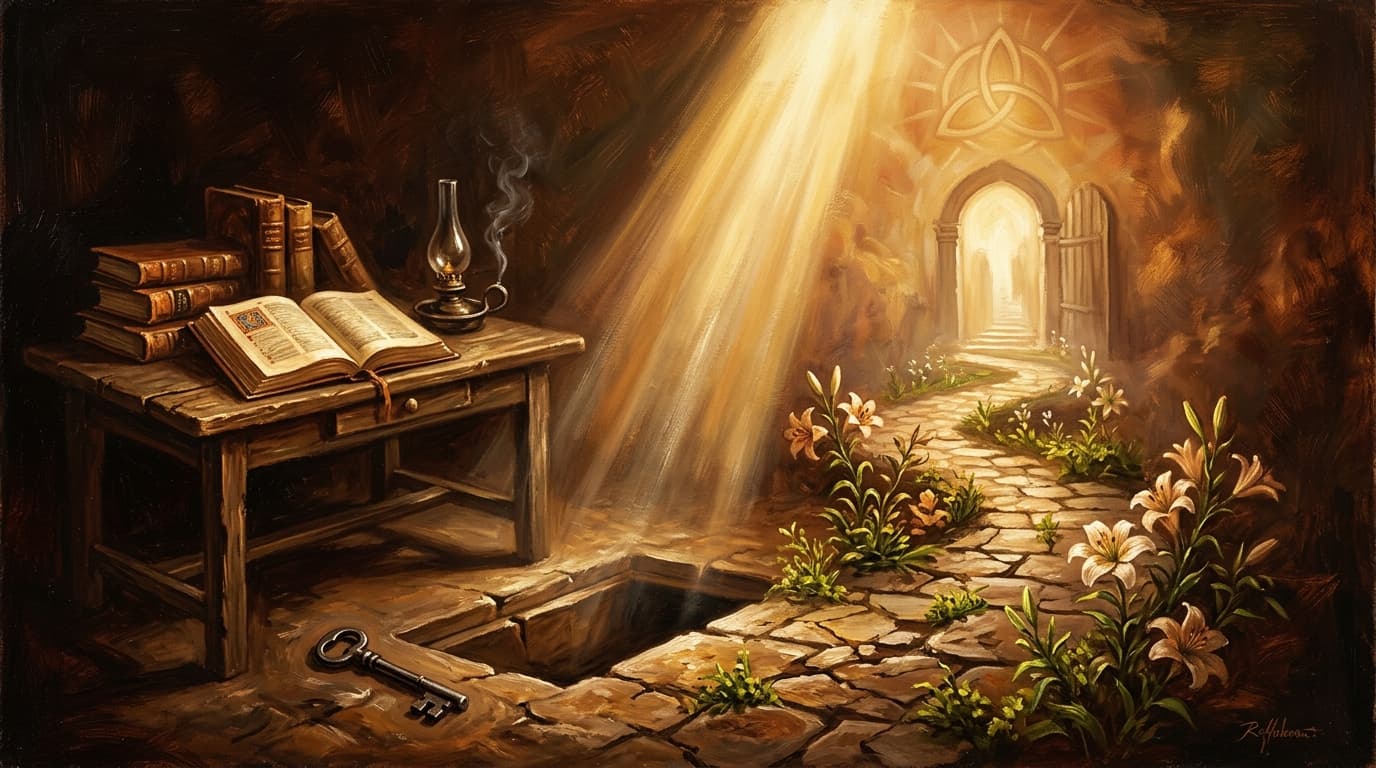
As we started with the question of what the Bible says about death, we end with a renewed understanding. The biblical narrative assures us that death is not the final word. In Christ, it becomes the doorway to resurrection and eternal life, where hope shines beyond the grave.
Scripture in this article
References
- 1 Corinthians 15:50-58biblegateway.com
- Matthew 22:23-33biblegateway.com
- Luke 20:27-40biblegateway.com
- Revelation 20:11-15biblegateway.com
- 1 Thessalonians 4:13-18biblegateway.com
- Augustine of Hippoen.wikipedia.org
- Thomas Aquinasen.wikipedia.org
- Orthodox Churchorthodoxwiki.org
- Reformed traditiontheopedia.com
- John Calvinen.wikipedia.org
- Martin Lutheren.wikipedia.org
- N.T. Wrighten.wikipedia.org
- C.S. Lewisen.wikipedia.org