What Is Easter? Meaning and History of the Christian Celebration
What is Easter and why does it matter? Explore the history, biblical roots, and theology of the Christian celebration of Christ's resurrection.
The unexpected center of the Christian narrative
Suppose you were to ask a first-century Christian what the most important event in the life of Jesus was. You might expect them to say the crucifixion, given its profound sacrifice and its central place in the Gospel narratives. Yet, the early church seemed to have a different answer: the resurrection. This event was not just the happy ending to a tragic story; it was the turning point around which the entire narrative of Jesus' life and mission revolved. Why is the resurrection not merely an epilogue to the crucifixion but the very point of the whole story?
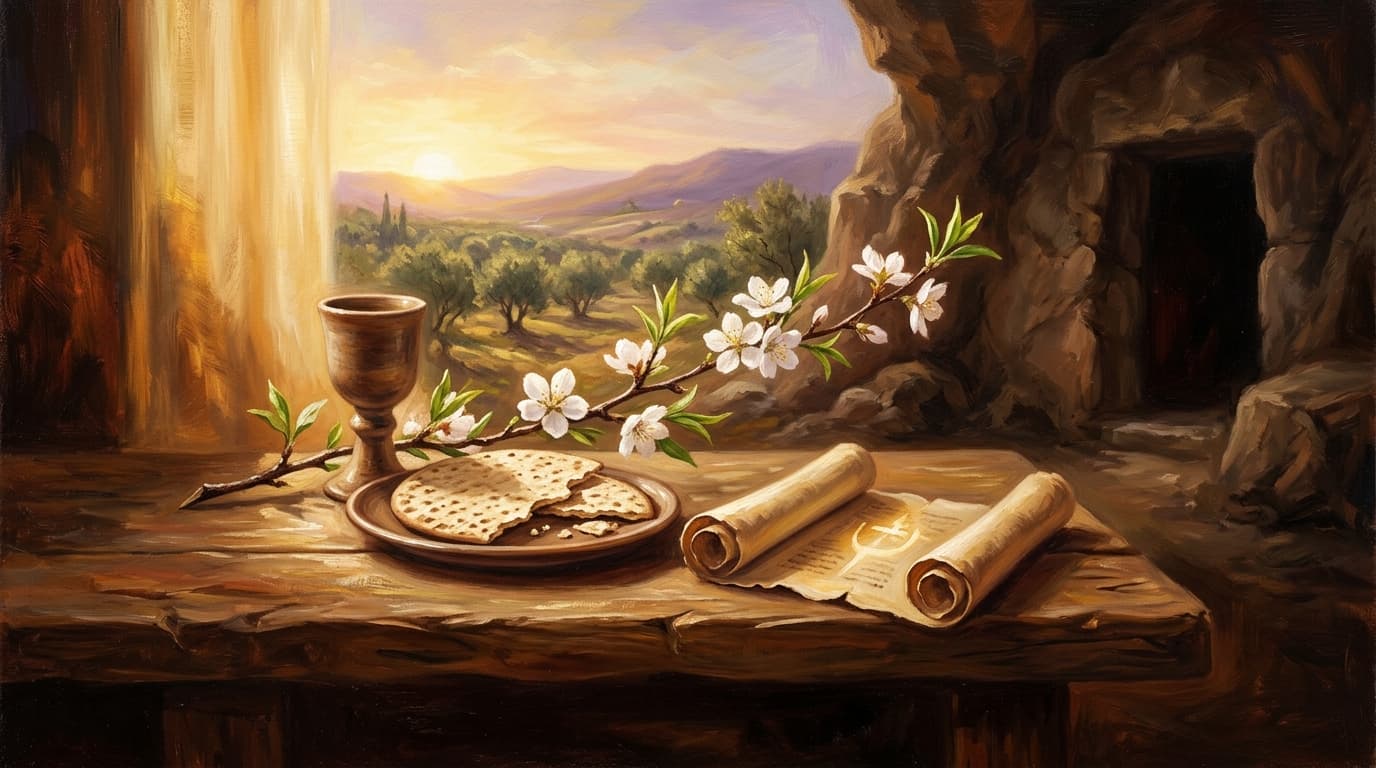
Let's begin with the Gospel of . Two women come to the tomb only to find it empty, an angel declaring, "He is not here; for He is risen, as He said." This moment is a hinge in history. It transforms despair into hope. The angel's words, simple yet profound, signify a victory that reshapes everything we understand about life, death, and eternity.
The resurrection: cornerstone, not footnote
One might object that the crucifixion is the true center because of its profound theological significance. Indeed, the crucifixion is indispensable, for it represents the atonement for sin. But consider the writings of the Apostle Paul in : "And if Christ has not been raised, then our preaching is in vain and your faith is in vain." The resurrection is the validation of Jesus' divine authority and the confirmation of His victory over sin and death. Without the resurrection, the crucifixion is a tragedy rather than a triumph.
John Calvin, in his Institutes of the Christian Religion, emphasizes that the resurrection was the manifestation of Christ's power that willfully overcame the grave, promising the same victory to all who believe. This belief was not merely theoretical but shaped the worship and theology of the church from its inception.
The firstfruits of those who have fallen asleep
The Apostle Paul uses the metaphor of "firstfruits" in : "But now Christ has been raised from the dead, the firstfruits of those who have fallen asleep." In agricultural terms, firstfruits are the initial yield of a harvest, a promise of more to come. Here, Paul speaks of Jesus as the first to rise in a new kind of life, promising that His followers will experience the same.
This is not merely about escaping death. It's about the inauguration of a new creation. As N.T. Wright articulates, the resurrection is not about life after death, but life after "life after death", a new kind of embodied life in God's renewed world.
Experiencing the resurrection today
How does this ancient event speak to us today? Consider the women at the tomb, as described in . They arrived prepared to anoint a dead body but left as the first evangelists of the risen Christ. Their encounter with the empty tomb marked a transformation from grief to mission, a journey from darkness into the light of dawn.
Likewise, the resurrection invites us into a new way of living. It challenges our perceptions of power, success, and significance. If the resurrection is true, then everything it touches is transformed. Death is not the end; it is a doorway.
Resurrection: a historical and theological foundation
Historically, the resurrection was the catalyst for the explosive growth of the early church. The apostles, once frightened and in hiding, became bold proclaimers of the Gospel because they had encountered the risen Christ. This historical event is recorded in multiple accounts, , , , and , each contributing to a robust tapestry of eyewitness testimony. If you want to go deeper into what the earliest historical sources say about the resurrection — including evidence that predates the Gospels — that evidence is more substantial than many people realise.
Gregory of Nyssa in his Great Catechism describes the resurrection as the light overcoming darkness, a metaphor that speaks as much to existential despair as it does to literal death. The resurrection is the dawn of a new era, one where the divine and mortal intertwine.
A dialogue with modern objections
One might argue, as some skeptics do, that the resurrection is a myth or metaphor rather than a historical event. It's worth acknowledging the tension here. As Athanasius of Alexandria argued in On the Incarnation, the resurrection defies natural explanation, requiring faith to bridge the gap between the seen and unseen.
Yet, the very absurdity of the resurrection in the ancient context, where bodily resurrection was as laughable as it is today, adds weight to its historical credibility. The early Christians did not invent this narrative to meet cultural expectations; they proclaimed it against them.
The resurrection as a living hope
Returning to the Apostle Peter's words in : "In His great mercy He has given us new birth into a living hope through the resurrection of Jesus Christ from the dead, and into an inheritance that can never perish, spoil or fade." The resurrection is not merely a past event but a present reality, shaping how we live and hope.
The resurrection invites each of us to ask, "If this is true, how then shall I live?" This question lingers, inviting us into a life transformed by the same power that raised Jesus from the dead.
The resurrection in Old Testament prophecy
The resurrection of Jesus Christ is not an isolated event in the New Testament but is deeply embedded within the Old Testament prophecies, reflecting a continuity in God's redemptive plan. For instance, the prophecy in speaks of the suffering servant who, after making a guilt offering, will see his offspring and prolong his days, suggesting a victory over death. The Psalmist also alludes to resurrection in , "For you will not abandon my soul to Sheol, or let your holy one see corruption." Peter, in his sermon at Pentecost, interprets this psalm as a foretelling of Christ's resurrection ().
Theologian N.T. Wright emphasizes that these prophecies were not mere predictions but were embedded in the Jewish understanding of God's covenantal faithfulness. Wright argues that the resurrection was the fulfillment of the promises made to Israel, where the Messiah would conquer death and establish God's kingdom (Wright, "The Resurrection of the Son of God"). The resurrection thus becomes a testament to God's faithfulness and the inauguration of a new era, emphasizing the transformation from a kingdom anticipated to a kingdom realized.
Concrete examples from the Old Testament include the story of Jonah, who spent three days in the belly of the fish (), a typological precursor to Christ's resurrection after three days in the tomb. Similarly, the vision of the valley of dry bones in signifies restoration and life after death, symbolizing the hope of resurrection for all of God's people.
The resurrection and Christian identity
The resurrection of Jesus is central to the identity of Christians, shaping both individual and communal life. Paul articulates this in , stating, "I have been crucified with Christ. It is no longer I who live, but Christ who lives in me." This transformation indicates that through the resurrection, believers participate in the life of Christ, redefining their existence and purpose.
Dietrich Bonhoeffer, in his work "The Cost of Discipleship," emphasizes that the resurrection calls Christians to live a life of radical discipleship, marked by a commitment to the teachings of Jesus, even unto death. Bonhoeffer suggests that the resurrection power enables believers to live out the Sermon on the Mount, embodying the values of the Kingdom of God in a world that often opposes them.
In practical terms, the resurrection empowers Christians to engage with the world through acts of love and justice, reflecting the life of the risen Christ. Community practices such as baptism, as described in , symbolize dying and rising with Christ, reinforcing the believer's new identity. Through the resurrection, Christians are called to be ambassadors of reconciliation (), living out the hope and renewal that Easter signifies.
Resurrection and eschatological fulfillment
The resurrection is a foretaste of the eschatological fulfillment that Christians anticipate, where God's promises will be fully realized. As Paul states in , the resurrection signals the ultimate defeat of all powers opposed to God, culminating in the final destruction of death. This eschatological hope shapes Christian understanding of history and the future, viewing the resurrection as the beginning of new creation.
Theologian Jurgen Moltmann, in "Theology of Hope," argues that the resurrection is not merely a past event but a future reality that breaks into the present. Moltmann posits that the resurrection instills hope that transforms how Christians engage with a world marked by suffering and death. This eschatological perspective encourages believers to live with a vision of God's future, working towards justice and peace as signs of the coming Kingdom.
Concrete examples of this eschatological hope can be seen in the Christian celebration of the Eucharist. As believers partake in communion, they proclaim the Lord's death until he comes (), embodying the tension between the "already" and the "not yet" of God's kingdom. This practice reinforces the reality of the resurrection and the anticipation of its complete fulfillment in God's redemptive plan.
The resurrection and its impact on early Christian worship
The resurrection of Jesus profoundly shaped the worship practices of the early Christian community. Unlike the Jewish Sabbath, which was observed on Saturday, the early Christians gathered for worship on the first day of the week, Sunday, to commemorate the day of Jesus' resurrection. This practice is evident in , where the disciples gathered to break bread, and in , where Paul instructs the church to set aside offerings on the first day of the week.
The theologian Justo L. González notes that this shift from the Sabbath to the Lord's Day was not merely a change in scheduling but a theological statement. It declared the resurrection as the axis around which Christian life revolved. It was a weekly celebration of victory over death, which reinforced the hope and joy found in the Christian faith. The resurrection was not just an annual event commemorated at Easter but a continual celebration that shaped the identity and practice of the early church.
Moreover, the Eucharist, or Communion, became a central element of Christian worship, symbolizing the death and resurrection of Jesus. The breaking of bread and sharing of the cup were not merely ritualistic acts but profound expressions of the resurrection's power in the believer's life. As the church father Ignatius of Antioch wrote, the Eucharist was "the medicine of immortality," a means by which believers participated in the life-giving power of the resurrection.
The resurrection and its ethical implications
The ethical implications of the resurrection are significant within Christian theology. The Apostle Paul, in , emphasizes that through baptism, believers are united with Christ in his death and resurrection, leading to a new way of living. This transformative aspect calls believers to embody the values of the resurrection in their daily lives.
The resurrection as a call to ethical living is further explored by theologians such as N.T. Wright, who argues that the resurrection is not just about life after death but about the renewal of creation and the establishment of God's kingdom on earth. This kingdom ethic demands justice, mercy, and humility, as believers are called to reflect the character of the risen Christ in their interactions with others.
Concrete examples of this can be seen in the early Christian communities, which were known for their radical generosity and care for the marginalized. The resurrection inspired them to create inclusive communities that transcended social, economic, and ethnic barriers. The teachings of Jesus, such as those found in the Sermon on the Mount, were not merely aspirational but became the ethical framework by which Christians lived, empowered by the hope of the resurrection.
Resurrection and the renewal of creation
The resurrection of Jesus is a foretaste of the ultimate renewal of creation. In , Paul speaks of creation itself waiting with eager expectation for the sons of God to be revealed, a promise tied to the resurrection. Theologian Jürgen Moltmann emphasizes that the resurrection is the beginning of the new creation, where the brokenness of the world will be restored.
The resurrection offers a vision of hope that extends beyond individual salvation to the redemption of the entire cosmos. This eschatological hope is not only future-oriented but also has present implications. Christians are called to participate in God's redemptive work in the world, working towards justice, peace, and the healing of creation.
An illustrative example of this is the Christian environmental movement, which sees care for creation as an integral part of living out the resurrection. Initiatives like community gardens, conservation efforts, and advocacy for sustainable practices are ways in which believers live out the hope of the resurrection, anticipating the day when creation will be fully renewed.
The resurrection and interfaith dialogue
The resurrection of Jesus is a unique tenet of the Christian faith, and its implications extend into the realm of interfaith dialogue. Understanding the resurrection's meaning can help Christians engage with people of other faiths in meaningful conversations. The resurrection challenges exclusivist and triumphalist attitudes, calling Christians to witness with humility and love.
In , Paul speaks at the Areopagus, addressing a diverse audience and using the resurrection as the cornerstone of his message. His approach exemplifies how the resurrection can be a bridge rather than a barrier in dialogue. The theologian Hans Küng argues that authentic interfaith dialogue requires mutual respect and a willingness to learn from one another while remaining true to one's beliefs.
In practical terms, this means focusing on shared values and concerns, such as peace, justice, and compassion, while recognizing the unique hope that the resurrection offers. By approaching dialogue with a resurrection-shaped perspective, Christians can contribute to a more harmonious coexistence, demonstrating the transformative power of Christ's victory over death in a pluralistic world.
The resurrection and personal transformation
The resurrection is not only a historical event but also a catalyst for personal transformation. In , Paul expresses his desire to know Christ and the power of his resurrection, indicating that the resurrection has a profound impact on the believer's life. Theologian Dietrich Bonhoeffer emphasized the cost and call of discipleship, which involves being conformed to the image of the resurrected Christ.
This transformation is both spiritual and moral, as believers are invited to live in the light of the resurrection. It means embracing a new identity as children of God, marked by hope, love, and a renewed purpose. The resurrection empowers believers to overcome personal struggles, such as addiction, fear, and despair, offering a path to freedom and wholeness.
Stories of personal transformation abound within the Christian community. Testimonies of individuals who have experienced profound change in their lives illustrate the ongoing impact of the resurrection. Whether it is breaking free from destructive habits or finding new purpose after a significant loss, the resurrection offers a powerful narrative of redemption and new beginnings.
Conclusion: the dawn of new creation
As we come full circle, we return to the women at the empty tomb. Their story, much like ours, does not end with an empty grave but with a world forever changed. The resurrection is not an epilogue but the prologue of a new creation, one that invites each of us to step into the light of Easter morning.
If you find yourself wondering how the resurrection can transform your life today, the answers may be as surprising and transformative as the event itself.