What Happened on Good Friday?
Explore the profound events of Good Friday, from the crucifixion of Jesus to the mysterious darkness and the tearing of the temple curtain. This day reshaped the spiritual landscape forever.
What happened on Good Friday?
Good Friday remembers the day Jesus was tried, condemned, crucified, died, and was buried. The Gospels present it as the dark center of Holy Week: human injustice reaches its height, and God turns even the cross toward redemption.
Good Friday timeline: the events of Jesus' final day
| Event | Gospel focus |
|---|---|
| Jesus is tried before the Jewish leaders and Pilate | Innocence, false accusation, and political pressure |
| Jesus is mocked and led to Golgotha | The suffering servant is rejected |
| Jesus is crucified between criminals | The King is enthroned on a cross |
| Darkness falls and Jesus dies | Judgment, grief, and victory meet |
| Joseph of Arimathea buries Jesus | The Sabbath begins with hope hidden in a tomb |
Why is it called Good Friday?
It is called Good Friday because Christians look back from Easter and see that the worst human evil became the place where God accomplished salvation. The day is not good because suffering is good; it is good because Christ's self-giving love is stronger than sin and death.
The stage of Good Friday: A moment in history
It is a curious thing to consider a day that ended in darkness as the beginning of a new dawn. Good Friday, the day of Jesus' crucifixion, is often shrouded in mystery and solemnity, yet it is a pivot upon which the wheel of history turned. Suppose we could travel back to that Friday, walk the dusty streets of Jerusalem, and stand amidst the throngs at Golgotha. What would we see? Would we grasp its seismic significance?
The events of Good Friday are chronicled across all four Gospels, each providing a unique perspective, much like witnesses to a historical event each seeing through their own lens. This day, marked by suffering and extraordinary cosmic signs, is crucial not only to Christian theology but to understanding the trajectory of human history.
The crucifixion of Jesus: An act of divine paradox
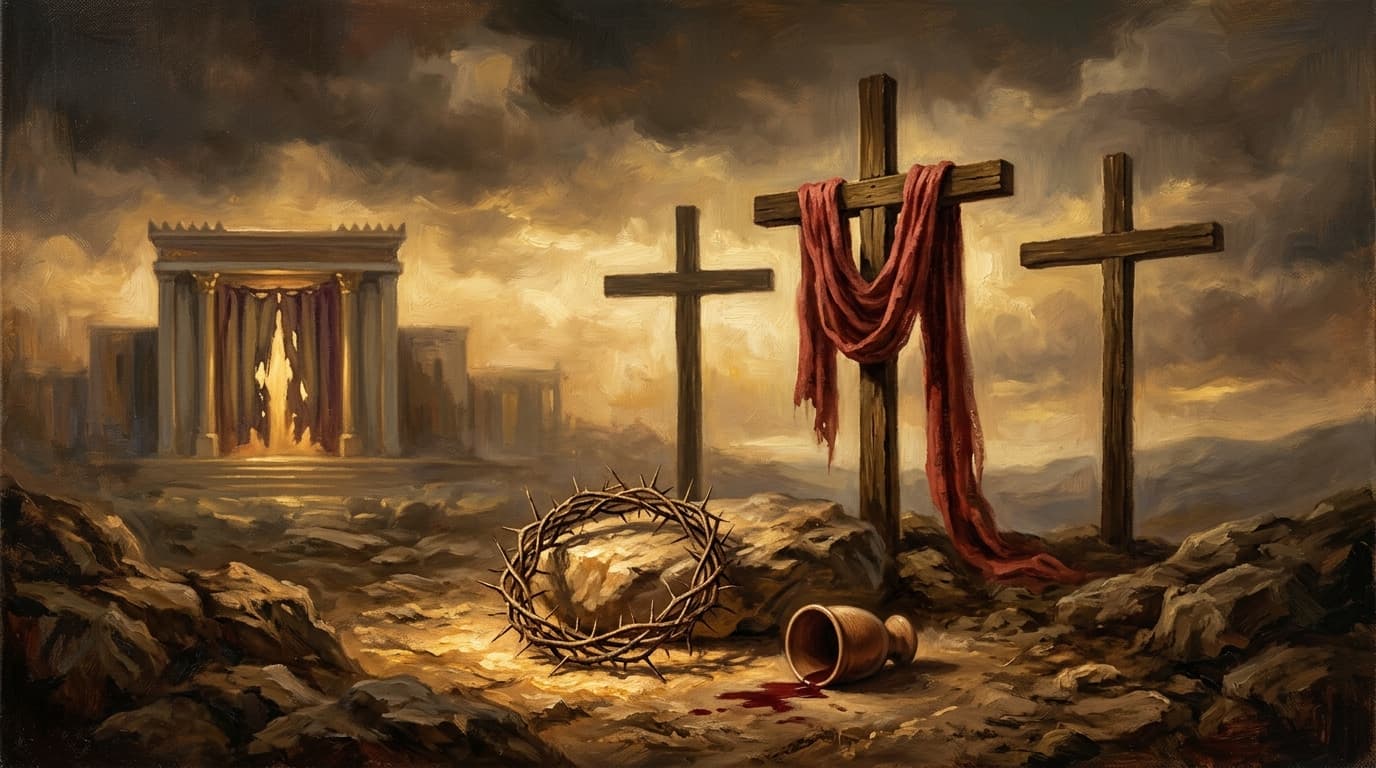
The crucifixion is a narrative of paradoxes. As depicts, Jesus was mocked as "King of the Jews," crowned not with gold but with thorns. This public humiliation, intended as a spectacle of defeat, was, in truth, the enthronement of a King whose kingdom was not of this world.
In the Gospel of , we find Simon of Cyrene compelled to carry the cross behind Jesus. His act symbolizes something profound: the involuntary participation of humanity in the suffering of Christ. As Simon trudged to Golgotha, the weight he bore was more than wood; it was emblematic of humanity's sin.
John Chrysostom, in his Homilies on the Gospel of Matthew, speaks to this mystery by noting how Jesus bore the cross as a trophy over tyranny, a symbol of a greater victory. His words echo through the ages: "He went forth bearing the Cross as a trophy over the tyranny of death."
The torn curtain: An end to separation
One of the most enigmatic moments of Good Friday is the tearing of the temple curtain, recounted vividly in . This curtain separated the Holy of Holies, the most sacred space where only the high priest could enter, from the rest of the temple. Its tearing was not merely a physical act but a profound theological statement.
N.T. Wright, in his reflections on the crucifixion, posits that this tearing signifies the end of the old covenant and the commencement of God's new project. No longer was access to God restricted; the barrier had been removed, symbolically proclaiming that through Christ, all could now enter the presence of God. This act transformed the relationship between the divine and humanity, God's grace made manifest.
Darkness at noon: The cosmic sign
The Gospels speak of an eerie darkness that fell over the land from the sixth to the ninth hour, as recorded in and . This phenomenon, possibly an eclipse or a supernatural event, underscores the gravity of the moment, a creation mourning its Creator.
Origen of Alexandria noted, "And the multitudes that were come together to the sight returned and smote upon their breasts." The darkness was more than physical; it was a spiritual veil, obscuring the light until the moment of resurrection.
The last words: A cry of completion
Jesus' final words from the cross, "It is finished" (), carry a weight that theologians have pondered for centuries. This declaration, in the original Greek, "Tetelestai," means "paid in full." It is a legal term indicating that a debt has been settled. This is not a cry of defeat but of accomplishment.
Charles Spurgeon, in his sermon on the final words of Christ, illuminates this truth, stating that "it was the divine purpose of God being fulfilled." The crucifixion was not an end but a culmination of Jesus' earthly mission, the payment for sin fulfilled in a single, sacrificial act.
The theological implications: A new covenant
The crucifixion of Jesus did not just mark a historical death but inaugurated a new covenant between God and humanity. As articulates, "Christ is the mediator of a new covenant, that those who are called may receive the promised eternal inheritance." This new covenant is characterized by grace, where the law is fulfilled not by human effort but through faith in Christ.
Theologian Charles Hodge speaks to this in his Systematic Theology, highlighting that the work of Christ was designed "to secure the pardon of original sin and the gift of the Holy Spirit for all." The crucifixion, therefore, is foundational to Christian theology, shaping doctrines of atonement and redemption.
The enduring mystery: Why did Jesus die?
One might object that a loving God would not require such a brutal sacrifice. But consider the nature of sin and justice. Sin, in its essence, is a rebellion against the divine order, and justice requires atonement. The crucifixion of Jesus is the intersection where divine love meets divine justice. It is not that God demands blood; rather, God, in Christ, absorbs the consequence of sin to restore the relationship.
N.T. Wright challenges us to see beyond a transactional view of atonement, understanding it within the narrative arc of Scripture. "A new sort of power will be let loose upon the world," he writes, "the power of self-giving love." This is the heart of the revolution launched on Good Friday.
The role of the Roman authorities: Political dynamics
On Good Friday, the role of the Roman authorities is an essential facet to understand the historical and political dynamics at play. The Roman governor Pontius Pilate found himself navigating a complex situation. As the representative of Roman power in Judea, Pilate was tasked with maintaining order and ensuring the stability of Roman rule. The Gospels present Pilate as a somewhat reluctant participant in the crucifixion of Jesus, highlighting his attempts to avoid condemning an innocent man. In , Pilate famously asks, "What is truth?" before declaring, "I find no basis for a charge against him."
The political tension is evident in the interactions between Pilate and the Jewish leaders. They pressured Pilate by suggesting that failing to execute Jesus would indicate disloyalty to Caesar (). This political maneuvering underscores the precarious balance Pilate had to maintain; he had to appease the Jewish authorities while simultaneously upholding Roman law and order. The trial and crucifixion of Jesus reveal the complexities of governance in a volatile region and illustrate how Jesus' death was not only a theological event but also a political one.
Theologian N.T. Wright argues that understanding Pilate's role is crucial because it places Jesus' death within the broader context of Roman imperial power, demonstrating how the kingdom of God confronts earthly empires. It highlights the paradox of Jesus, the King of the Jews, being executed by the Roman state, a theme that resonates throughout the Christian narrative as a triumph of divine justice over political expediency.
The fulfillment of prophecy: Old Testament connections
Good Friday is profoundly linked to the fulfillment of Old Testament prophecies, lending depth to its significance. The crucifixion of Jesus is seen as the culmination of messianic prophecies, particularly those found in the book of Isaiah. is often cited as a prophetic foreshadowing of Jesus' suffering and death. In , it is written, "But he was pierced for our transgressions, he was crushed for our iniquities; the punishment that brought us peace was on him, and by his wounds we are healed."
Jesus himself alluded to the fulfillment of these prophecies during his ministry. In , he stated, "Everything must be fulfilled that is written about me in the Law of Moses, the Prophets, and the Psalms." The events of Good Friday are thus seen as a divine orchestration that fulfills the ancient promises of salvation. This connection underscores the continuity of God's salvific plan through history, bridging the Old and New Testaments.
Theologians such as John Calvin have emphasized the importance of prophecy in understanding Christ's work, arguing that these fulfillments affirm Jesus' identity as the Messiah and validate the reliability of Scripture. The prophetic connections highlight the divine purpose behind the events of Good Friday, reinforcing the belief that Jesus' suffering was not an accident of history but a divinely ordained act of redemption.
The significance of the witnesses: Eyewitness accounts
The presence of witnesses at the crucifixion of Jesus adds a layer of authenticity and emotional gravity to the events of Good Friday. The Gospels record various individuals who were present during Jesus' final hours, including the centurion, women followers, and certain disciples. In , the centurion and those with him, upon witnessing the earthquake and Jesus' death, declared, "Surely he was the Son of God!" This moment of recognition signifies the impact of Jesus' death even on those who were initially outsiders to his teachings.
The women who followed Jesus, including Mary Magdalene and Mary, the mother of James and Joses, are noted for their steadfast presence (). Their role as witnesses underscores the courage and faithfulness of those who remained close to Jesus in his suffering. These eyewitnesses serve as crucial links in the transmission of the Good Friday narrative, providing testimony that would form the foundation of early Christian proclamation.
Renowned theologian Karl Barth emphasized the importance of these witnesses in understanding the historical reality of the crucifixion. He argued that their accounts provide a tangible connection to the events, grounding the theological implications of Good Friday in real human experience. The testimony of the witnesses not only affirms the historical occurrence of Jesus' death but also invites believers to enter into the narrative, seeing themselves as part of a long line of witnesses to the power and mystery of the cross.
The concept of sacrifice: A theological exploration
The concept of sacrifice in the context of Good Friday is pivotal to understanding the theological implications of Jesus' crucifixion. Sacrifice, within the biblical tradition, is deeply rooted in the idea of atonement and reconciliation with God. The sacrificial system of the Old Testament, particularly the Day of Atonement rituals described in , provides a backdrop to Jesus' sacrifice. The high priest would offer sacrifices to atone for the sins of the people, a practice that symbolized the cleansing of sin and restoration of the covenant relationship with God.
Jesus' death is framed as the ultimate sacrifice, fulfilling and transcending the old sacrificial system. In , it is stated, "We have been made holy through the sacrifice of the body of Jesus Christ once for all." This notion of a "once for all" sacrifice emphasizes the completeness and sufficiency of Christ's offering. It signifies the end of the need for continual sacrifices, as Jesus' death provides a permanent means of reconciliation with God.
Theologian Anselm of Canterbury's theory of atonement highlights the necessity of Christ's sacrifice to satisfy divine justice and restore the broken relationship between humanity and God. Good Friday, therefore, is not merely an event of historical significance but a profound theological statement about the nature of God's love and the means of human redemption. The concept of sacrifice on Good Friday invites believers to reflect on the cost of their redemption and the depth of divine love that prompted such an act.
The impact on the disciples: From despair to mission
The events of Good Friday had a profound impact on Jesus' disciples, transforming their lives and setting the stage for the birth of the early Church. Initially, the crucifixion brought despair and confusion. The disciples had followed Jesus with the hope that he would establish God's kingdom in a manner they understood. However, witnessing his crucifixion shattered those expectations, leaving them in fear and doubt. In , it is recorded, "Then everyone deserted him and fled," highlighting their initial response of abandonment and fear.
Yet, the despair of Good Friday was not the end of the story for the disciples. The resurrection of Jesus and the subsequent appearances to his followers transformed their fear into faith and their despair into mission. The Apostle Peter, who had denied Jesus three times, became a bold proclaimer of the Gospel, as seen in , where he preached with conviction at Pentecost.
This transformation from despair to mission is a testament to the power of the resurrection and the work of the Holy Spirit. John Stott, in his writings, emphasizes that the disciples' transformation is evidence of the reality of the resurrection, which turned the tragedy of Good Friday into the triumph of Easter. The impact on the disciples is an inspiration for believers, illustrating how the events of Good Friday and the resurrection can transform personal despair into a life of purpose and mission for the Kingdom of God.
Walking home: The journey of faith
As we go back to our opening thought experiment, envisioning ourselves as bystanders at the crucifixion, we realize that Good Friday is not merely an event to be commemorated but a reality to be lived. We, like those who witnessed the crucifixion, must walk home, carrying the weight of this day in our hearts. The journey does not end with the cross but begins anew with the empty tomb.
The story of Good Friday invites us into a deeper understanding of the cosmic and personal implications of Jesus' death. It is a call to embrace the paradox of the cross, a symbol of death that brings life, a moment of darkness that heralds light. As we reflect on this day, we are reminded that we are still walking home, our paths illuminated by the light of resurrection.
Related guide on non-retaliation
For a first-century example of justice without retaliation, see Turn the Other Cheek: What Jesus Actually Meant.